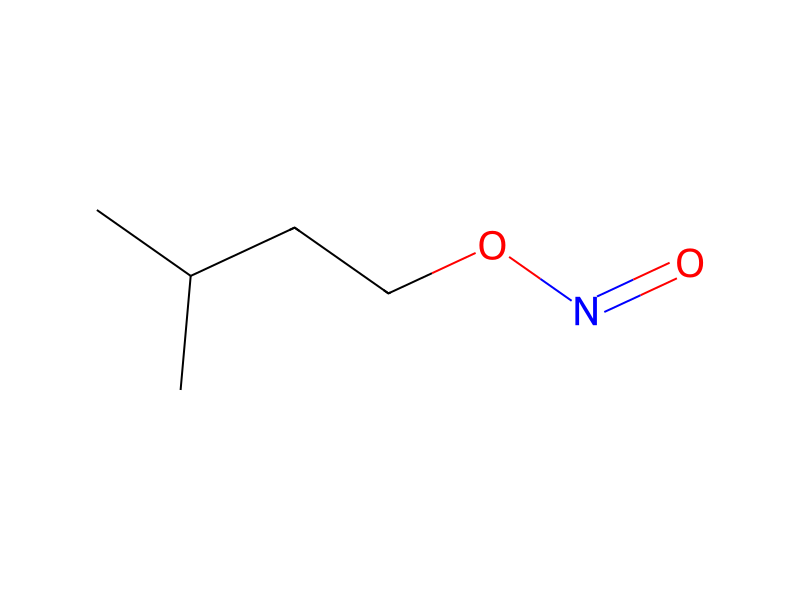
Isoamyl Nitrite → HCID 12017585, compound
Reaction equation

C(ON=O)CC(C)C.O[PH2]=O.[CH3:12][C:13]1([CH3:31])[CH2:22][CH2:21][C:20]([CH3:24])([CH3:23])[C:19]2[CH:18]=[C:17]([C:25]([O:27][CH2:28][CH3:29])=[O:26])[CH:16]=[C:15]([Br:30])[C:14]1=2>>[CH3:31][C:13]1([CH3:12])[CH2:22][CH2:21][C:20]([CH3:23])([CH3:24])[C:19]2[CH:18]=[C:17]([C:25]([O:27][CH2:28][CH3:29])=[O:26])[CH:16]=[C:15]([Br:30])[C:14]1=2.[CH3:12][C:13]1([CH3:31])[CH2:22][CH2:21][C:20]([CH3:23])([CH3:24])[C:19]2[CH:18]=[C:17]([C:25]([OH:27])=[O:26])[CH:16]=[C:15]([Br:30])[C:14]1=2Participants


Procedure
Reaction Schemes 1 and 2 provide examples for the synthesis of derivatives of 5,6,7,8-tetrahydro-5,5,8,8-tetramethyl-naphthalene-2-carboxylic acid, which are within the scope of Formula 6 and which are reacted with an amine of Formula 7 to provide (5,6,7,8-tetrahydro-5,5,8,8-tetramethyl-naphthalene-2-yl)carbamoyl derivatives within the scope of Formula 1. Thus, as is shown in Reaction Scheme 1, ethyl 5,6,7,8-tetrahydro-5,5,8,8-tetramethylnaphthalene-2-carboxylate (Compound A) is nitrated to provide the corresponding 3-nitro compound (Compound B). The nitro group of Compound B is reduced to provide the corresponding 3-amino compound (Compound C) which is described in the publication Lehmann et al. Cancer Research, 1991, 51, 4804. Ethyl 5,6,7,8-tetrahydro-5,5,8,8-tetramethyl-3-aminonaphthalene-2-carboxylate (Compound C) is brominated to yield the corresponding 4-bromo derivative (Compound D), which is converted by treatment with isoamylnitrite and reduction with H3PO2, to ethyl 5,6,7,8-tetrahydro-5,5,8,8-tetramethyl-4-bromonaphthalene-2-carboxylate (Compound E). Saponification of Compound E yields 5,6,7,8-tetrahydro-5,5,8,8-tetramethyl-4-bromonaphthalene-2-carboxylic acid (Compound F) which is used as a reagent in accordance with Formula 6. Ethyl 5,6,7,8-tetrahydro-5,5,8,8-tetramethyl-3-aminonaphthalene-2-carboxylate (Compound C) is also diazotized and reacted with HBF4 to provide ethyl 5,6,7,8-tetrahydro-5,5,8,8-tetra-methyl-3-fluoronaphthalene-2-carboxylate (Compound G) which serves either per se or after saponification as a reagent in accordance with Formula 6.
Sources & evidence
- ORD record
- ord-f48072a669c244c5b2784da3300902b6
- Source dataset
- uspto-grants-1999_10
- Patent number
- US05965606
Reaction notes
Loading…