Thiophene → Cyclopentyl-2-thienylmethanone
Reaction equation

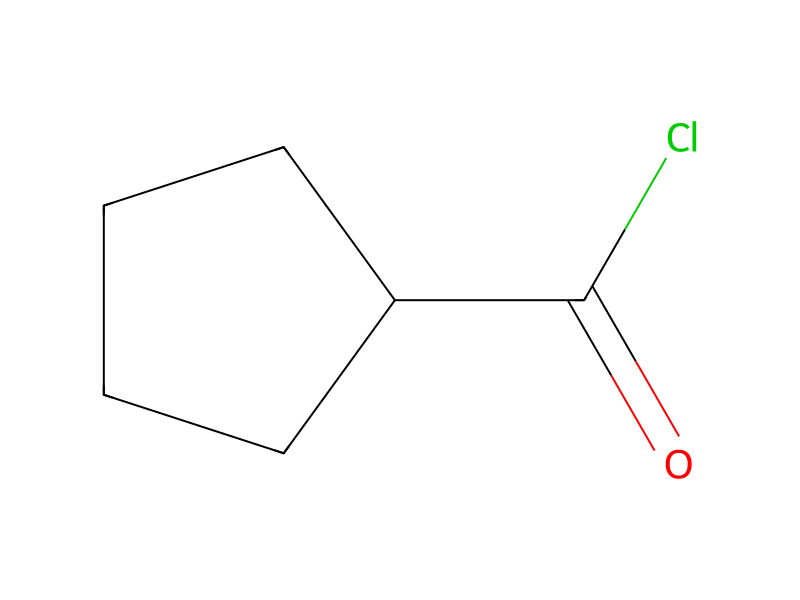
[S:1]1[CH:5]=[CH:4][CH:3]=[CH:2]1.[CH:6]1([C:11](Cl)=[O:12])[CH2:10][CH2:9][CH2:8][CH2:7]1>ClC1C=CC=CC=1Cl>[S:1]1[CH:5]=[CH:4][CH:3]=[C:2]1[C:11]([CH:6]1[CH2:10][CH2:9][CH2:8][CH2:7]1)=[O:12]Participants
Reactant 2

Product 1

Reagents, catalysts & solvents 1

Procedure
Graphite (6.0 g) was added to a mixture of thiophene (2.46 g, 29.2 mmol) and cyclopentanecarboxylic acid chloride (29.2 mmol assumed--the crude mixture from Example 1) in 50 mL of o-dichlorobenzene. The mixture was heated and kept at 80° C. for 1.5 hours. It is understood that lower temperatures can be used for longer times, or higher temperatures for shorter times while achieving good yields of cyclopentyl 2-thienyl ketone. After cooling down to room temperature, graphite was removed by filtration and washed with a small portion of the o-dichlorobenzene solvent. The product mixture was subjected to mild heating to remove the residual amount of HCl. The crude cyclopentyl 2-thienyl ketone of 84% purity (GC, area % analysis) was transferred, without purification, to the bromination step of Example 3.
Workup
- temperatureThe mixture was heated
Sources & evidence
- ORD record
- ord-6c087a6bead845b2b5fce0ea9cfb89eb
- Source dataset
- uspto-grants-1999_10
- Patent number
- US05969159
Reaction notes
Loading…