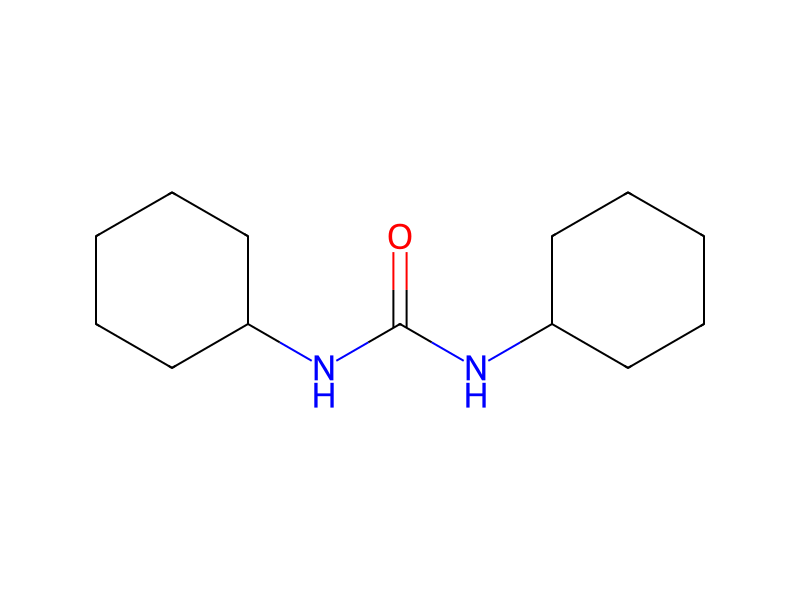
Dicyclohexylcarbodiimide → N,N'-Dicyclohexylurea
Reaction equation

[OH:1]N1C(=O)CCC1=O.[CH:9]1([N:15]=[C:16]=[N:17][CH:18]2[CH2:23][CH2:22][CH2:21][CH2:20][CH2:19]2)[CH2:14][CH2:13][CH2:12][CH2:11][CH2:10]1>CS(C)=O>[CH:18]1([NH:17][C:16](=[O:1])[NH:15][CH:9]2[CH2:10][CH2:11][CH2:12][CH2:13][CH2:14]2)[CH2:23][CH2:22][CH2:21][CH2:20][CH2:19]1Participants
4
Reactant 2


Product 1
Reagents, catalysts & solvents 1

Procedure
To a solution consisting of 0.3 g (0.67 mmol) N-(2-aminoethyl) trans-1,2-diaminocyclohexane-N,N',N',N",N"pentaacetic acid in 20 ml dimethylsulfoxide was added 0.62 g (5.4 mmol) N-hydroxysuccinimide and 0.41 g (2.0 mmol) dicyclohexylcarbodiimide. This was stirred at room temperature for 24 hr. A white fluffy solid of dicyclohexyl urea formed in the reaction and was filtered. The filtrate was concentrated to a thick oil under reduced pressure. A solid precipitated from the oil upon the addition of acetonitrile. This solid was collected, washed with acetonitrile and dried under vacuum to give 0.25 g of the final product. NMR showed an average of 2 NHS esters so the yield is 58%. No further purification was attempted; mp 100°-130° C.
Sources & evidence
- ORD record
- ord-2629d2dcdd73418b8c46ed7f19db65b0
- Source dataset
- uspto-grants-1994_08
- Patent number
- US05334729
Reaction notes
Loading…