Nitric Acid → 5-Bromo-4-fluoro-2-hydroxy-3-nitrobenzoic Acid
Reaction equation
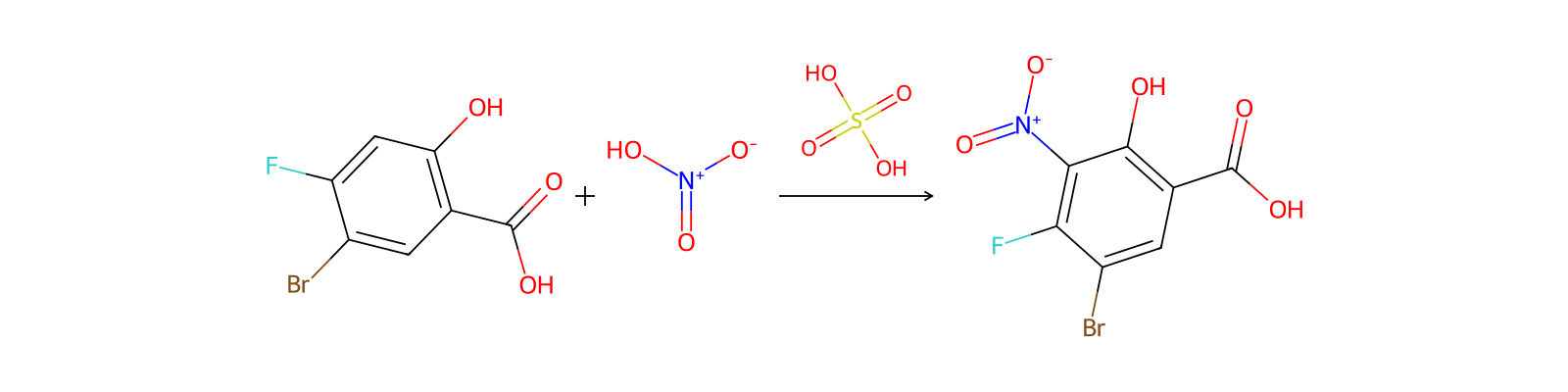
[Br:1][C:2]1[C:3]([F:12])=[CH:4][C:5]([OH:11])=[C:6]([CH:10]=1)[C:7]([OH:9])=[O:8].[N+:13]([O-])([OH:15])=[O:14]>S(=O)(=O)(O)O>[Br:1][C:2]1[C:3]([F:12])=[C:4]([N+:13]([O-:15])=[O:14])[C:5]([OH:11])=[C:6]([CH:10]=1)[C:7]([OH:9])=[O:8]Participants
Reactant 2


Product 1

Reagents, catalysts & solvents 1

Conditions
- Temperature
- 0 °C
Procedure
5-Bromo-4-fluoro-2-hydroxybenzoic acid (I-227) (34.39 g, 0.146 mol) was dissolved in concentrated sulfuric acid (260 ml), and cooled at 0° C. At the same temperature, fuming nitric acid (d=1.52) (6.67 ml, 0.161 mol) was dropwise added with keeping the inner temperature at 0° C. or lower (about 20 minutes). After the addition, the disappearance of the starting material was confirmed by TLC, then the reaction liquid was gradually poured into ice. The aqueous layer was extracted with ethyl acetate, the organic layer was washed with saturated brine, then dried over anhydrous sodium sulfate, and the solvent was evaporated away. N-hexane was added to the residue, the crystal was ground, the suspension was stirred at room temperature for 1 hour (optionally with sonication). The crystal was washed with n-hexane, followed by filtration and drying to obtain the entitled compound (33.82 g, 83%) as an orange solid.
Workup
- customat 0° C.
- customlower (about 20 minutes)
- additionAfter the addition
- customthe reaction liquid
- additionwas gradually poured into ice
- extractionThe aqueous layer was extracted with ethyl acetate
- washthe organic layer was washed with saturated brine
- dry with materialdried over anhydrous sodium sulfate
- customthe solvent was evaporated away
- additionN-hexane was added to the residue
- customoptionally with sonication)
- washThe crystal was washed with n-hexane
- filtrationfollowed by filtration
- customdrying
Sources & evidence
- ORD record
- ord-839d0d414c4d4518bb061043d2ed5d4c
- Source dataset
- uspto-grants-2010_06
- Patent number
- US07737166B2
Reaction notes
Loading…