HuagongsheHuagongshe Chemistry Print Report · For research reference only
HRID 1753670Generated: October 30, 2026
Hydrochloric Acid → HCID 117666646, compound
https://huagongshe.com/reaction/1753670
Participants
| Role | Name | HCID | Charge |
|---|
| Reactant | Hydrochloric Acid | HCID 313 | — |
| Reactant | 4-Chlorobutyryl chloride | HCID 78370 | — |
| Reactant | Triphenylsulfonium 1,1-difluoro-2-hydroxyethanesulfonate | HCID 86632756 | — |
| Reactant | HCID 87186540 | HCID 87186540 | — |
| Catalyst | 4-(Dimethylamino)pyridine | HCID 14284 | — |
| Solvent | Dichloromethane | HCID 6344 | — |
| Solvent | Triethylamine | HCID 8471 | — |
| Product | HCID 117666646 | HCID 117666646 | 78.5% |
Reaction Steps
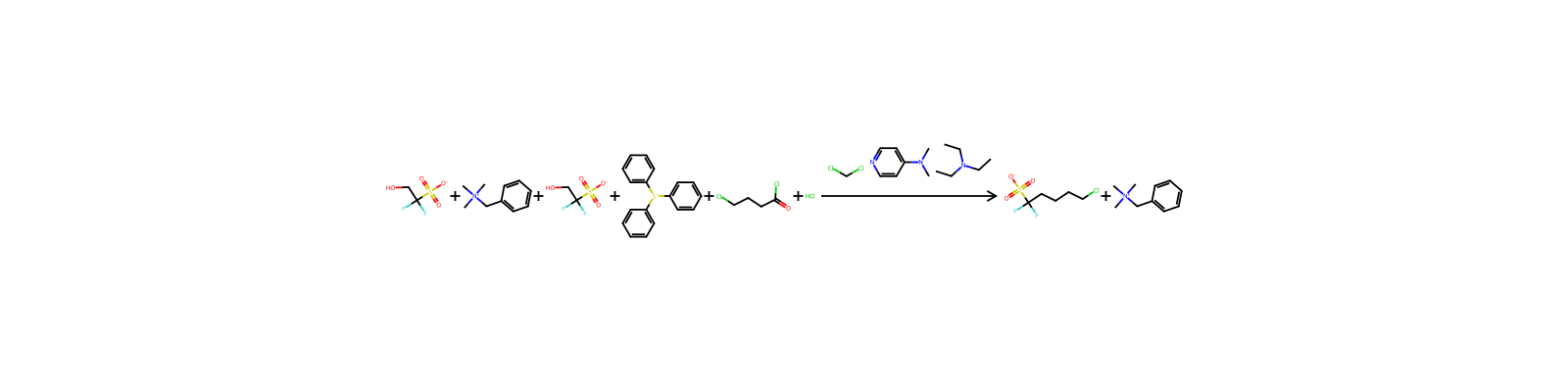
In 60 g of methylene chloride were dissolved 16 g of benzyltrimethylammonium 1,1-difluoro-2-hydroxyethanesulfonate which had been prepared with reference to the synthesis of triphenylsulfonium 1,1-difluoro-2-hydroxyethanesulfonate described in JP-A 2009-258695 (U.S. Pat. No. 8,114,570), 7.6 g of triethylamine, and 0.6 g of 4-dimethylaminopyridine. Under ice cooling, a mixture of 8.5 g chlorobutyryl chloride and 20 g methylene chloride was added dropwise to this solution, followed by 4 hours of stirring. At the end of stirring, 50 g of 5 wt % dilute hydrochloric acid was added to quench the reaction. The organic layer was separated, washed with water, and concentrated in vacuum. To the concentrate, 100 g of MIBK was added. This was concentrated in vacuum again. The residue was washed with diisopropyl ether, obtaining 15 g of the target compound, benzyltrimethylammonium 2-(3-chloropropyl)-1,1-difluoroethanesulfonate as oily matter. Yield 74%.
Provenance & Evidence
| DOI | 10.6084/m9.figshare.5104873.v1 |
|---|
| Patent number | US09164384B2 |
|---|
| Source dataset | uspto-grants-2015_10 |
|---|
| ORD ID | ord-d48b341f5bc8418fa2a076d4da805ab0 |
|---|
| Source note | uspto-grants-2015_10 |
|---|