HuagongsheHuagongshe Chemistry Print Report · For research reference only
HRID 17567Generated: October 27, 2026
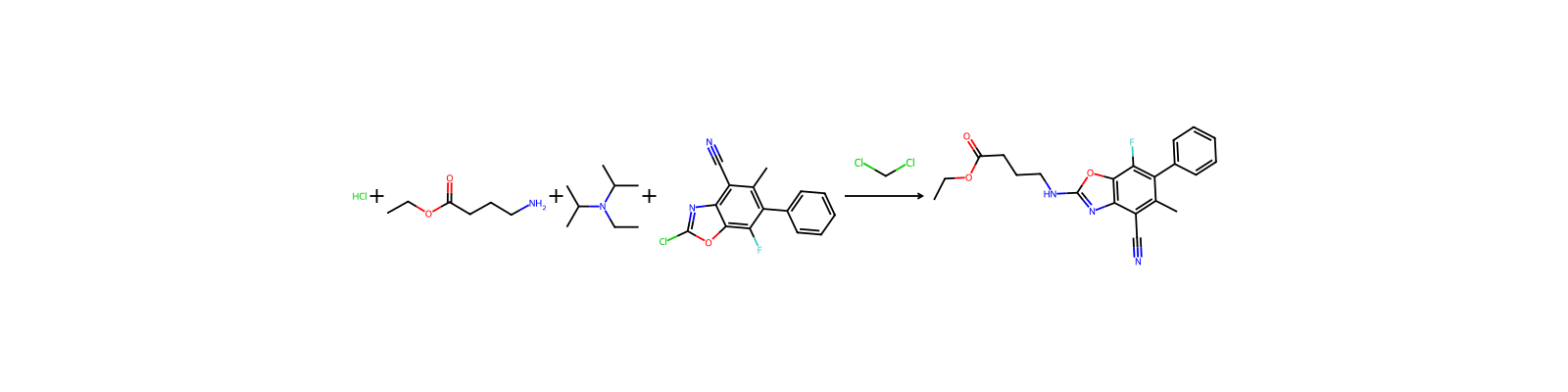
Diisopropylethylamine → Ethyl 4-[(4-cyano-7-fluoro-5-methyl-6-phenyl-1,3-benzoxazol-2-yl)amino]butanoate
https://huagongshe.com/reaction/17567
Participants
| Role | Name | HCID | Charge |
|---|
| Reactant | Diisopropylethylamine | HCID 81531 | — |
| Reactant | 4-Aminobutyrate ethyl hydrochloride | HCID 12649661 | — |
| Reactant | 2-Chloro-7-fluoro-5-methyl-6-phenyl-1,3-benzoxazole-4-carbonitrile | HCID 51041429 | — |
| Solvent | Dichloromethane | HCID 6344 | — |
| Product | Ethyl 4-[(4-cyano-7-fluoro-5-methyl-6-phenyl-1,3-benzoxazol-2-yl)amino]butanoate | HCID 51039317 | 99% |
Reaction Steps
With cooling with ice, ethyl 4-aminobutanoate hydrochloride (149 mg, 0.892 mmol) and diisopropylethylamine (303 μl, 1.78 mmol) were added to a dichloromethane (7 ml) solution of 2-chloro-7-fluoro-5-methyl-6-phenyl-1,3-benzoxazole-4-cabonitrile (I-130) (213 mg, 0.743 mmol), followed by stirring at room temperature for 15 hours. The reaction liquid was concentrated under reduced pressure, ethyl acetate was added, followed by washing with saturated brine. After drying over anhydrous sodium sulfate, the insoluble matter was separated by filtration, and the residue obtained by concentration was purified by silica gel column chromatography (eluent, n-hexane:ethyl acetate=2:1→1:1, v/v) to obtain the entitled compound (279 mg, 99%) as a white solid.
Provenance & Evidence
| DOI | 10.6084/m9.figshare.5104873.v1 |
|---|
| Patent number | US07737166B2 |
|---|
| Source dataset | uspto-grants-2010_06 |
|---|
| ORD ID | ord-fb2454710843437e9f5796ddf51d79d1 |
|---|
| Source note | uspto-grants-2010_06 |
|---|