HuagongsheHuagongshe Chemistry Print Report · For research reference only
HRID 1756790Generated: October 25, 2026
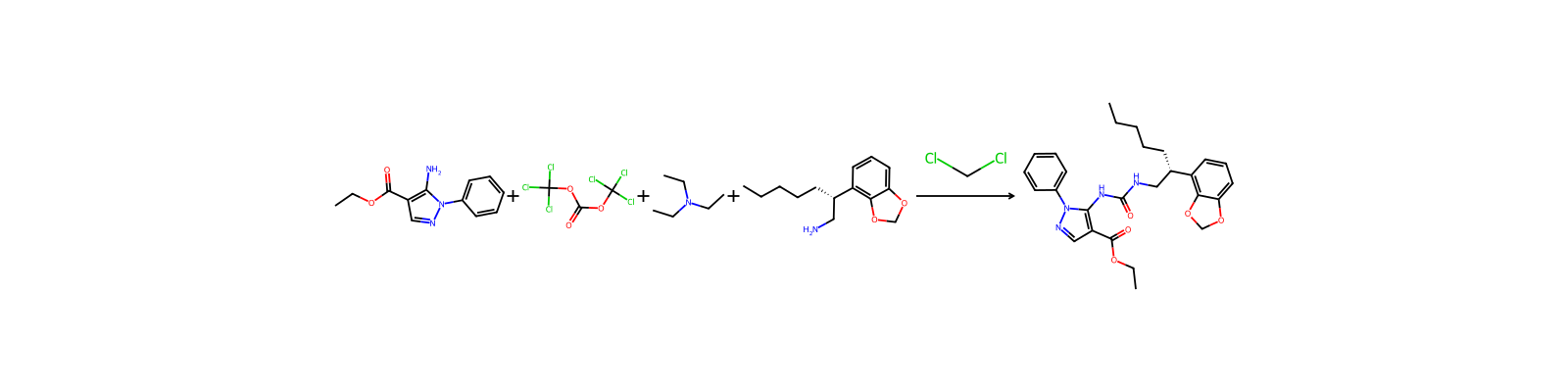
Triethylamine → (R)-1-[2-(2, 3-methylenedioxyphenyl) heptyl]-3-(4-ethoxycarbonyl-1-phenylpyrazole-5-yl) urea
https://huagongshe.com/reaction/1756790
Participants
| Role | Name | HCID | Charge |
|---|
| Reactant | Triethylamine | HCID 8471 | — |
| Reactant | Ethyl 5-amino-1-phenyl-1H-pyrazole-4-carboxylate | HCID 85270 | — |
| Reactant | Triphosgene | HCID 94429 | — |
| Reactant | (R)-2-(2, 3-methylenedioxyphenyl) heptylamine | HCID 10331642 | — |
| Solvent | Dichloromethane | HCID 6344 | — |
| Product | (R)-1-[2-(2, 3-methylenedioxyphenyl) heptyl]-3-(4-ethoxycarbonyl-1-phenylpyrazole-5-yl) urea | HCID 53777275 | 220.5% |
Reaction Steps
To a mixture of 1.16 g of 5-amino-1-phenylpyrazole-4-carboxylic acid ethyl ester and 10 ml of methylene chloride were dropwise added 0.53 g of bis (trichloromethyl) carbonate and 1.11 g of triethylamine in order with ice cooling and stirring, and the resultant mixture was refluxed with heating for 4 hours. The reaction mixture was allowed to cool to room temperature, mixed with a solution of 1.18 g of (r)-2-(2, 3-methylenedioxyphenyl) heptylamine in 3 ml of methylene chloride, stirred at room temperature for 2 hours and the solvent evaporated. Water was added to the residue, and the mixture was extracted with ethyl acetate. The organic layer was washed with saturated saline, dried over anhydrous sodium sulfate and the solvent evaporated. The residue was chromatographed on a column of silica gel, eluting with ethyl acetate and n-hexane (2:5) to give 1.94 g of the titled compound as amorphous solid.
Provenance & Evidence
| DOI | 10.6084/m9.figshare.5104873.v1 |
|---|
| Patent number | US05442060 |
|---|
| Source dataset | uspto-grants-1995_08 |
|---|
| ORD ID | ord-769b42aab1084e97b859d74b202a31d3 |
|---|
| Source note | uspto-grants-1995_08 |
|---|