2,2-Dimethylchroman → 2,2-Dimethylchroman-8-carboxylic acid
Reaction equation
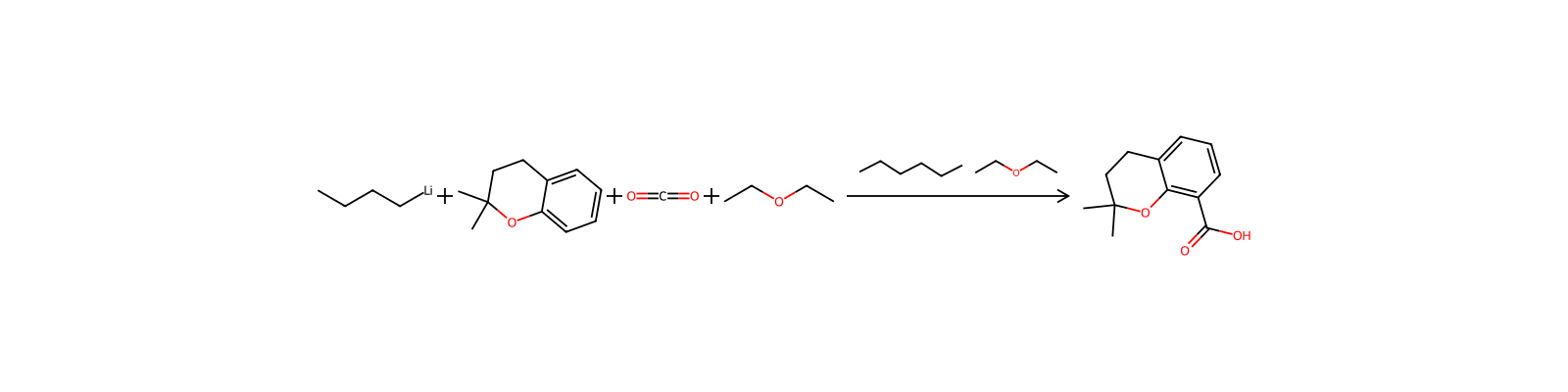
C([Li])CCC.[CH3:6][C:7]1([CH3:17])[CH2:16][CH2:15][C:14]2[C:9](=[CH:10][CH:11]=[CH:12][CH:13]=2)[O:8]1.[C:18](=[O:20])=[O:19].C(OCC)C>CCCCCC.C(OCC)C>[CH3:6][C:7]1([CH3:17])[CH2:16][CH2:15][C:14]2[C:9](=[C:10]([C:18]([OH:20])=[O:19])[CH:11]=[CH:12][CH:13]=2)[O:8]1Participants
Reactant 3



Product 1

Reagents, catalysts & solvents 2


Procedure
To a solution of 1.6M n-butyllithium in hexane and 150 ml of diethyl ether were added a solution of 27 g of 2,2-dimethylchroman in diethyl ether over a one hour period at room temperature. The solution was then heated at reflux 160 minutes, cooled, and poured into dry ice/diethyl ether. The mixture was allowed to come to room temperature, poured into ice water, and layers separated. The organic layer was washed with water, dried over sodium sulfate, and concentrated in vacuo to provide 21 g of solid. The aqueous layer was acidified and the resulting precipitate extracted into diethyl ether/ethyl acetate. The organic extract was washed with water, dried over sodium sulfate, and concentrated in vacuo to provide 9 g of solid. The two isolated solids were combined and chromatographed over silica gel eluting with 10% ethyl acetate in toluene. The appropriate fractions were combined and concentrated in vacuo to provide 9.8 g of the desired title intermediate, m.p. 90°-92° C.
Workup
- temperatureThe solution was then heated
- temperatureat reflux 160 minutes
- temperaturecooled
- customto come to room temperature
- customseparated
- washThe organic layer was washed with water
- dry with materialdried over sodium sulfate
- concentrationconcentrated in vacuo
Sources & evidence
- ORD record
- ord-6d3f783b063b42aa872e5b940c48248f
- Source dataset
- uspto-grants-1995_08
- Patent number
- US05442078
Reaction notes
Loading…