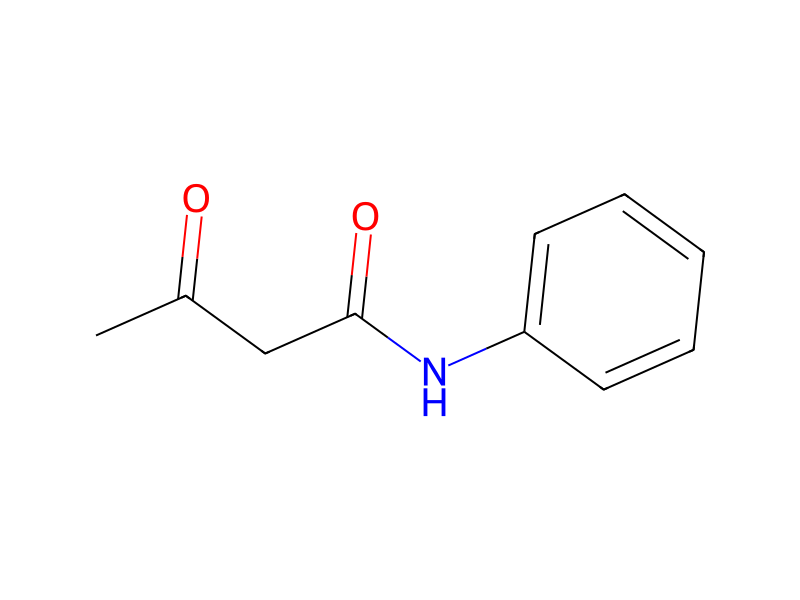
HCID 538490, compound → Acetoacetanilide
Reaction equation

Cl[C:2](Cl)([C:12]([CH3:14])=[O:13])[C:3]([NH:5][C:6]1[CH:11]=[CH:10][CH:9]=[CH:8][CH:7]=1)=[O:4].[H][H]>O.C1(C)C=CC=CC=1.[H][H]>[C:3]([NH:5][C:6]1[CH:11]=[CH:10][CH:9]=[CH:8][CH:7]=1)(=[O:4])[CH2:2][C:12]([CH3:14])=[O:13]Participants
Reactant 2


Product 1
Reagents, catalysts & solvents 3


Procedure
2.46 g (0.01 mole) of α,α-dichloroacetoacetanilide was dissolved in 20 ml of water and 30 ml of toluene, and dehalogenated with hydrogen using 5% Pd/C as catalyst. Hydrogen was allowed to react until no more would be absorbed. The first equivalent (251 ml at 739 mm pressure and 25° C.) was absorbed in 50 minutes (a rate of about 5 ml/min) whereas the 274 ml (second equivalent) was absorbed at the much slower rate of about 0.9 ml/min. On the basis of the hydrogen absorbed, it was concluded that the dehalogenation had proceeded to remove both chlorines and hence to give acetoacetanilide. This was confirmed by filtering off the catalyst, separating off the water phase and finally isolating the product from the toluene. Obtained were 1.57 g or 89% of acetoacetanilide, mp 79°-84° C.
Workup
- customto react until no more
- customwould be absorbed
- customThe first equivalent (251 ml at 739 mm pressure and 25° C.) was absorbed in 50 minutes (a rate of about 5 ml/min) whereas the 274 ml (second equivalent)
- customwas absorbed at the much slower rate of about 0.9 ml/min
- customOn the basis of the hydrogen absorbed
- customto remove both chlorines
Sources & evidence
- ORD record
- ord-00df3c290120427eb1a7a9cffe7c2c5b
- Source dataset
- uspto-grants-1995_08
- Patent number
- US05442115
Reaction notes
Loading…