Participants
| Role | Name | HCID | Charge |
|---|
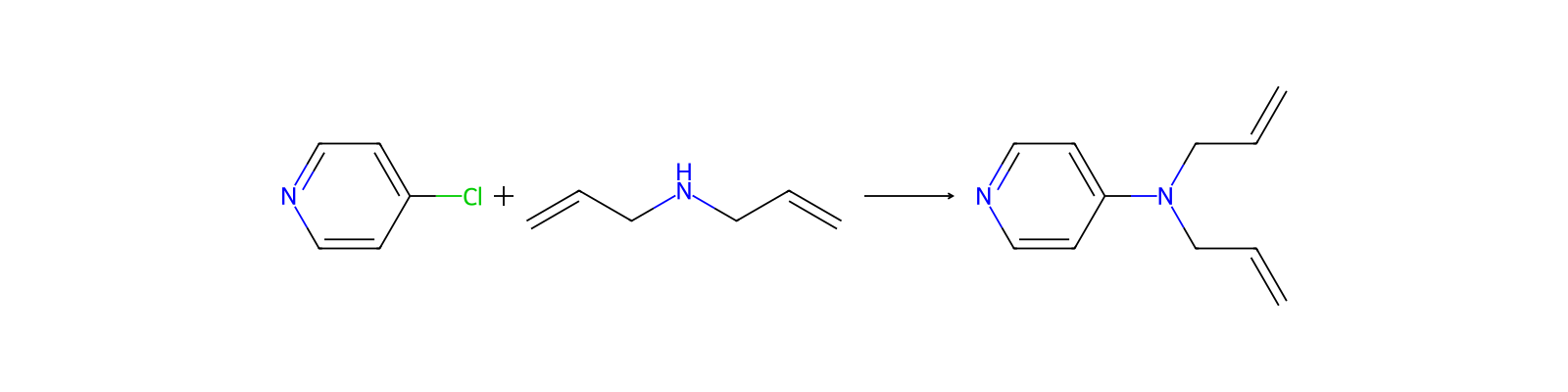
| Reactant | 4-Chloropyridine | HCID 12288 | — |
| Reactant | Diallylamine | HCID 31279 | — |
| Product | 4-(Diallylamino)pyridine | HCID 10877638 | 65% |
Reaction Steps
The title compound was prepared by hydrosilation of 4-diallylaminopyridine with dimethyl(ethoxy)silane, (EtO)Me2SiH. The 4-diallylaminopyridine was obtained by reaction of 4-chloropyridine with diallylamine. Thus, in an experiment similar to that described in Example 1, 4-chloropyridine (11.2 g; 0.10 mol) and diallylamine (14.6 g; 0.15 mol) were combined in an ampoule, degassed under vacuum, sealed and heated for three days at 130° C. The product mixture was dissolved in water, neutralized with 10% NaOH and extracted with several portions of diethyl ether. The ether solution was filtered, the solvent was evaporated, and the residue was distilled to give 4-diallylaminopyridine (11.3 g; 65%; b.p. 92° C. @ 0.25 torr). 4-Diallylaminopyridine (5.2 g; 0.030 mol), (EtO)Me2SiH (8.3 g; 0.080 mol), and H2PtCl6 (60 μL; 0.080 mol/L in isopropylalcohol (i--PrOH); 4.6×10 mol) were combined as in Example 1 and heated for 10 hours at 130° C. After reaction the product mixture was distilled under vacuum to give Silane 2a, N,N[bis(3-(dimethyl(ethoxy)silyl)propyl)-4-aminopyridine, as a colorless liquid (5.75 g; 50%; b.p. 142-146° C. @ 0.05 torr), which was also characterized by elemental analysis, infrared, 1H and 13C--NMR spectroscopy, and gas chromatography-mass spectrometry.
Provenance & Evidence
| DOI | 10.6084/m9.figshare.5104873.v1 |
|---|
| Patent number | US05442106 |
|---|
| Source dataset | uspto-grants-1995_08 |
|---|
| ORD ID | ord-5d1873bb973143ef935d2cabbca1c202 |
|---|
| Source note | uspto-grants-1995_08 |
|---|