Triethylamine → 2-Cyclopropyl-7-[(3S)-3-(dimethylamino)pyrrolidin-1-yl]-5-methyl-6-(pyrrol-1-yl)-1,3-benzoxazole-4-carbonitrile
Reaction equation

[CH:1]1([C:4]2[O:5][C:6]3[C:7](=[C:9]([C:20]#[N:21])[C:10]([CH3:19])=[C:11]([N:14]4[CH:18]=[CH:17][CH:16]=[CH:15]4)[C:12]=3F)[N:8]=2)[CH2:3][CH2:2]1.C(N(CC)CC)C.[CH3:29][N:30]([CH3:36])[C@H:31]1[CH2:35][CH2:34][NH:33][CH2:32]1.C(=O)([O-])O.[Na+]>CS(C)=O.C(OCC)(=O)C>[CH:1]1([C:4]2[O:5][C:6]3[C:7](=[C:9]([C:20]#[N:21])[C:10]([CH3:19])=[C:11]([N:14]4[CH:18]=[CH:17][CH:16]=[CH:15]4)[C:12]=3[N:33]3[CH2:34][CH2:35][C@H:31]([N:30]([CH3:36])[CH3:29])[CH2:32]3)[N:8]=2)[CH2:3][CH2:2]1Participants
Reactant 4


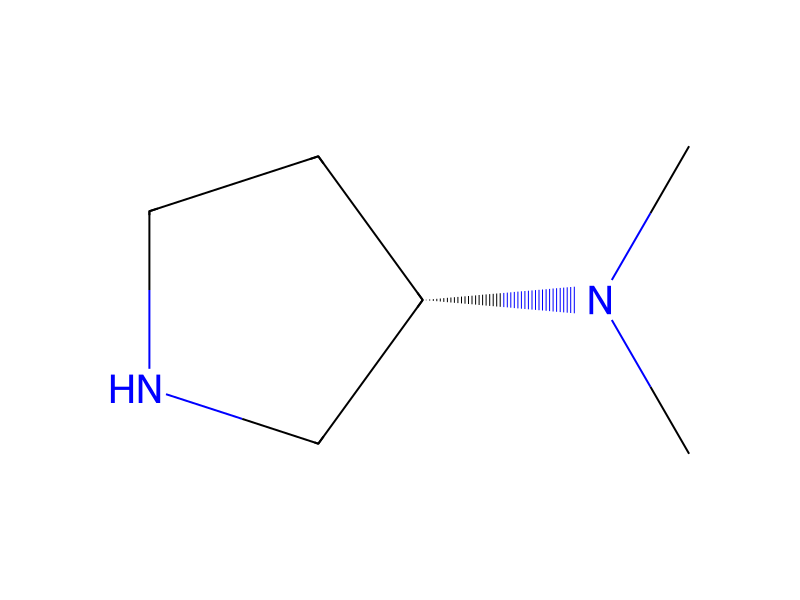

Product 1

Reagents, catalysts & solvents 2


Conditions
- Temperature
- 100 °C
Procedure
2-Cyclopropyl-7-fluoro-5-methyl-6-(pyrrol-1-yl)-1,3-benzoxazole-4-carbonitrile (I-320) (28 mg, 0.10 mmol) was dissolved in dimethyl sulfoxide (2 ml), then at room temperature, triethylamine (18 μl, 0.13 mmol) and (3S)-3-(dimethylamino)pyrrolidine (17 μl, 0.13 mmol) were added, followed by stirring under nitrogen atmosphere at 100° C. for 5.5 hours. The reaction liquid was cooled to room temperature, then fractionated with ethyl acetate and an aqueous saturated sodium hydrogencarbonate solution. The aqueous layer was further extracted twice with ethyl acetate. The organic layers were combined, washed with saturated brine, and dried over anhydrous sodium sulfate. The insoluble matter was separated by filtration, the solvent was evaporated away, and the resulting residue was roughly purified by preparative TLC (eluent, chloroform:methanol=92:8, v/v), and the obtained solid was further purified in slurry with diisopropyl ether. This was dried at 60° C. under reduced pressure for 12 hours to obtain the entitled compound (26.5 mg, 71%) as a white solid.
Workup
- customThe reaction liquid
- temperaturewas cooled to room temperature
- extractionThe aqueous layer was further extracted twice with ethyl acetate
- washwashed with saturated brine
- dry with materialdried over anhydrous sodium sulfate
- customThe insoluble matter was separated by filtration
- customthe solvent was evaporated away
- customthe resulting residue was roughly purified by preparative TLC (eluent, chloroform:methanol=92:8, v/v)
- customthe obtained solid was further purified in slurry with diisopropyl ether
- customThis was dried at 60° C. under reduced pressure for 12 hours
Sources & evidence
- ORD record
- ord-d513522d9c6541b6b48c02a56d32028d
- Source dataset
- uspto-grants-2010_06
- Patent number
- US07737166B2
Reaction notes
Loading…