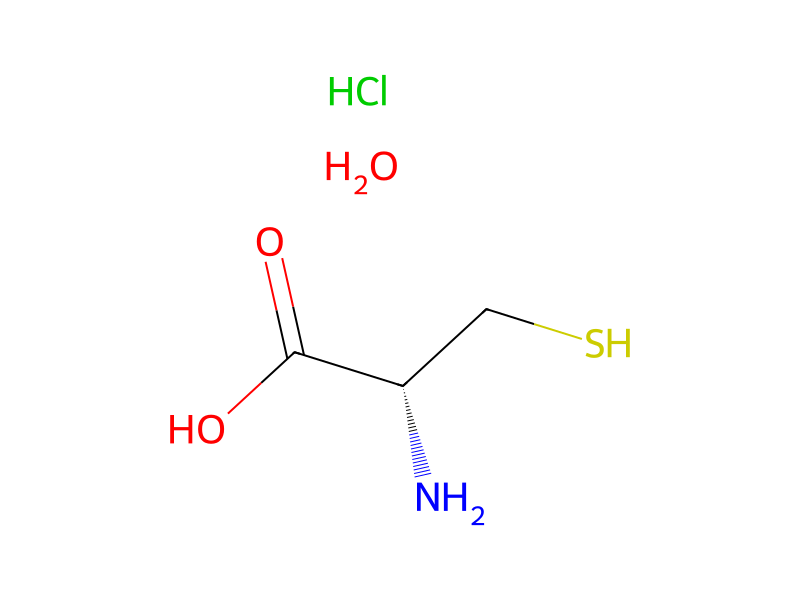
L-Cysteine hydrochloride monohydrate → HCID 56639285, compound
Reaction equation

O.Cl.[NH2:3][C@H:4]([C:7]([OH:9])=[O:8])[CH2:5][SH:6].[C:10]([O:14][C:15]([NH:17][CH2:18][CH2:19][CH2:20]Br)=[O:16])([CH3:13])([CH3:12])[CH3:11]>C(O)C.O.[OH-].[Na+]>[C:10]([O:14][C:15]([NH:17][CH2:18][CH2:19][CH2:20][S:6][CH2:5][C@@H:4]([C:7]([OH:9])=[O:8])[NH2:3])=[O:16])([CH3:13])([CH3:12])[CH3:11]Participants





Procedure
L-cysteine hydrochloride hydrate (13 g) was dissolved in a mixture of 100 ml of ethanol and 50 ml of water, and 2N-NaOH was added. While the solution was maintained at a pH of 10, 16 g of 3-(t-butoxycarbonylamino)propyl bromide was added. The mixture was stirred at room temperature for 4 hours. After neutralization, the reaction mixture was concentrated to dryness under reduced pressure. The residue was dissolved in 15% aqueous ammonia, and subjected to CHP20P column chromatography (0%→30% acetonitrile/water gradient). Fractions containing the desired product were concentrated under reduced pressure. The precipitated crystals were collected by filtration to give 10.3 g of S-(3-t-butoxycarbonylaminopropyl)-L-cysteine. mp. 193° C. (decomp.) An aliquot (3.0 g) of the product was dissolved in a water/THF solution containing 3.0 g of potassium carbonate, and with vigorous stirring, 2.76 g of benzyloxycarbonyl chloride was added. The mixture was stirred at room temperature for 3 hours. The reaction mixture was washed with ether, acidified with 10% citric acid, and extracted with chloroform. The organic layer was dried over anhydrous sodium sulfate and concentrated under reduced pressure to give 2.8 g of N-benzyloxycarbonyl-S-(3-t-butoxycarbonylaminopropyl)-L-cysteine as an oil. The dicyclohexylamine salt of this compound had a melting point of 125° to 127° C. An aliquot (1.76 g) of the oily product was dissolved in 20 ml of acetonitrile, and 0.43 g of N-hydroxysuccinimide and 0.77 g of N,N-dicyclohexylcarbodiimide were added to the solution. The mixture was stirred for 2 hours. The precipitate was removed by filtration, and chloroform was added to the mother liquor. The mixture was washed successively with saturated aqueous sodium bicarbonate solution and aqueous sodium chloride solution, dried over anhydrous sodium sulfate, and concentrated to dryness under reduced pressure to give 2.2 g of a powder. Sodium bicarbonate (0.6 g) and 1.07 g of (2S,3aS,7aS)-1-(gamma-D-glutamyl)octahydro-1H-indole-2-carboxylic acid were dissolved in a mixture of 24 ml of THF and 12 ml of water, and 2.2 g of the above powder was added to the solution. The mixture was stirred at room temperature for 3 hours. The reaction mixture was neutralized and concentrated under reduced pressure. The residue was acidified wit 5% aqueous potassium hydrogen-sulfate solution and subjected to CHP20P column chromatography (30%→70% acetonitrile/water gradient). Fractions containing the desired product were concentrated under reduced pressure to give 0.6 g of (2S,3aS,7aS)-1-[N-benzyloxycarbonyl-S-(3-t-butoxycarbonylaminopropyl)-L-cysteinyl-gamma-D-glutamyl]octahydro-1H-indole-2-carboxylic acid. An aliquot (0.58 g) of this product was worked up as in the fourth step of Example 27 to give 0.33 g of the captioned compound.
Workup
- additionwas added
- additionwas added
- concentrationAfter neutralization, the reaction mixture was concentrated to dryness under reduced pressure
- dissolutionThe residue was dissolved in 15% aqueous ammonia
- additionFractions containing the desired product
- concentrationwere concentrated under reduced pressure
- filtrationThe precipitated crystals were collected by filtration
Sources & evidence
- ORD record
- ord-2eed6f28e9e64717aa1ec9bf31620ee9
- Source dataset
- uspto-grants-1989_05
- Patent number
- US04826814
Reaction notes
Loading…