Pyridine → N-Nitroso-L-proline
Reaction equation

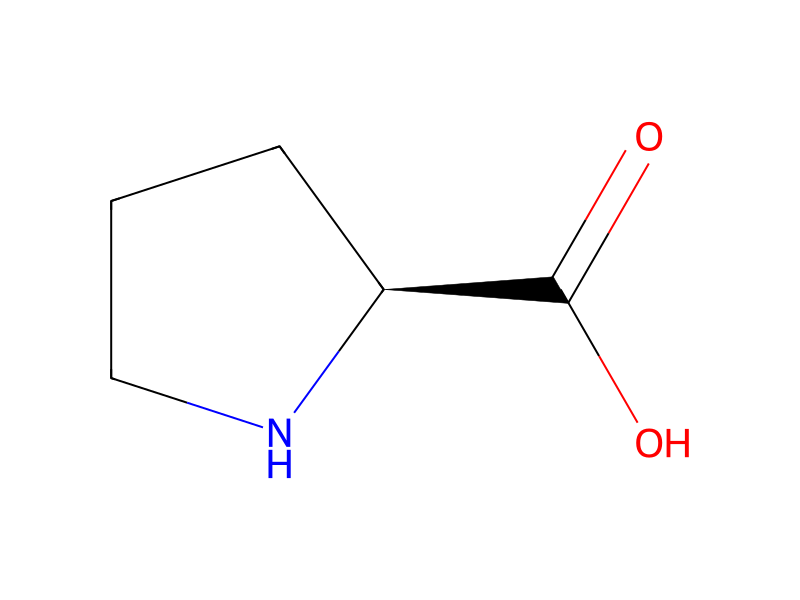
[B-](F)(F)(F)F.[N:6]#[O+:7].[NH:8]1[CH2:15][CH2:14][CH2:13][C@H:9]1[C:10]([OH:12])=[O:11].N1C=CC=CC=1>C(#N)C>[N:6]([N:8]1[CH2:15][CH2:14][CH2:13][C@H:9]1[C:10]([OH:12])=[O:11])=[O:7]Participants
Reactant 3


Product 1

Reagents, catalysts & solvents 1

Procedure
To a cooled suspension of 28.2 g. of nitrosyl tetrafluoroborate in 300 ml. of dry acetonitrile there is added, with vigorous stirring, over the course of 10 minutes, 18.4 g. of L-proline, followed by a solution of 19 g. of pyridine in 50 ml. of acetonitrile during 15 minutes. The stirring is continued for an hour and the reaction mixture is then concentrated to dryness under reduced pressure. The residue is extracted with 3×200 ml. of ethyl acetate, the ethyl acetate extracts are combined, washed twice with saturated sodium chloride solution that has been made slightly acidic with concentrated hydrochloric acid. The ethyl acetate solution is dried over anhydrous sodium sulfate, filtered and concentrated to dryness at room temperature under reduced pressure. The product, N-nitroso-L-proline melts at 108°-109° (dec.) after crystallization from a mixture of ether and petroleum ether (30°-60° ).
Workup
- additionTo a cooled suspension of 28.2 g
- waitThe stirring is continued for an hour
- concentrationthe reaction mixture is then concentrated to dryness under reduced pressure
- extractionThe residue is extracted with 3×200 ml
- washwashed twice with saturated sodium chloride solution that
- dry with materialThe ethyl acetate solution is dried over anhydrous sodium sulfate
- filtrationfiltered
- concentrationconcentrated to dryness at room temperature under reduced pressure
- customThe product, N-nitroso-L-proline melts at 108°-109° (dec.) after crystallization
- additionfrom a mixture of ether and petroleum ether (30°-60° )
Sources & evidence
- ORD record
- ord-f17f2e847c0c46ecad255d442cc9f921
- Source dataset
- uspto-grants-1989_05
- Patent number
- US04833152
Reaction notes
Loading…