1-Butanol → HCID 20310361, compound
Reaction equation

Cl[C:2]1[N:3]=[N:4][C:5]([C:9]2[CH:14]=[CH:13][CH:12]=[C:11]([Cl:15])[CH:10]=2)=[CH:6][C:7]=1[CH3:8].C(O)CCC.[CH:21]([NH:23][NH2:24])=O.[Si]([O-])([O-])([O-])[O-].[Mg+2].[Mg+2]>C(Cl)Cl>[Cl:15][C:11]1[CH:10]=[C:9]([C:5]2[CH:6]=[C:7]([CH3:8])[C:2]3[N:3]([CH:21]=[N:23][N:24]=3)[N:4]=2)[CH:14]=[CH:13][CH:12]=1Participants
6



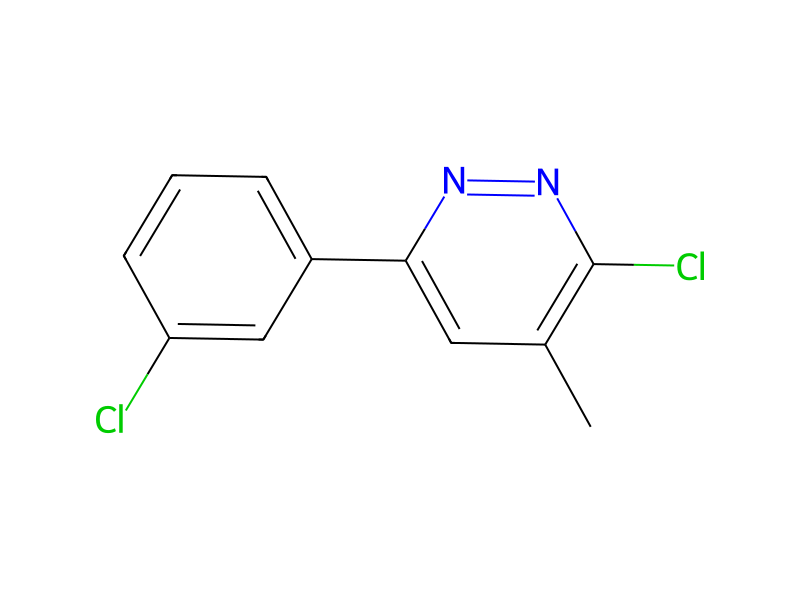


Procedure
A mixture of 2.0 g. of 3-chloro-6-(m-chlorophenyl)-4-methylpyridazine, 50 ml. of n-butanol and 1.08 g. of formylhydrazine is refluxed for 18 hrs. The mixture is concentrated to dryness under vacuum and the residue dissolved in methylene chloride. The solution is passed through a short column of hydrous magnesium silicate. The eluent is refluxed while hexane is added gradually until crystals separated. Cooling and filtering gives 1.20 g. of crystals, m.p. 173°-176° C. The crystals in methylene chloride are passed through a short column of hydrous magnesium silicate and the eluent concentrated with the addition of hexane to give 0.83 g. of crystals, m.p. 181°-182° C.
Workup
- additionA mixture of 2.0 g
- concentrationThe mixture is concentrated to dryness under vacuum
- dissolutionthe residue dissolved in methylene chloride
- temperatureThe eluent is refluxed while hexane
- additionis added gradually until crystals
- customseparated
- temperatureCooling
- filtrationfiltering
- customgives 1.20 g
- concentrationthe eluent concentrated with the addition of hexane
- customto give 0.83 g
Sources & evidence
- ORD record
- ord-83b7fa1aa7fb465981b30e85284de977
- Source dataset
- uspto-grants-1978_09
- Patent number
- US04112095
Reaction notes
Loading…