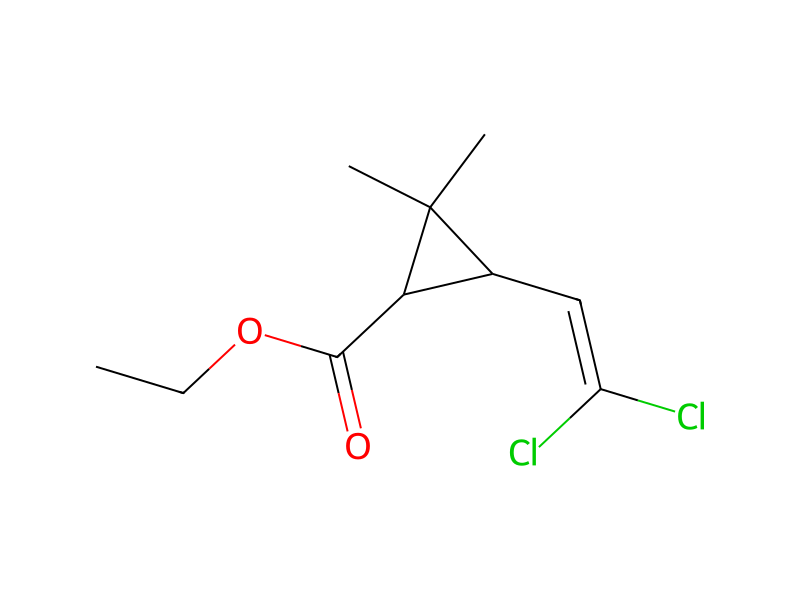
Dimethyl Sulfoxide → Cyclopropanecarboxylic acid, 3-(2,2-dichloroethenyl)-2,2-dimethyl-, ethyl ester
Reaction equation

[CH2:1]([O:3][C:4]([C:6]1(C(OCC)=O)[C:8]([CH3:10])([CH3:9])[CH:7]1[CH:11]=[C:12]([Cl:14])[Cl:13])=[O:5])[CH3:2].[Cl-].[Na+].CS(C)=O>O>[Cl:13][C:12]([Cl:14])=[CH:11][CH:7]1[C:8]([CH3:10])([CH3:9])[CH:6]1[C:4]([O:3][CH2:1][CH3:2])=[O:5]Participants
Reactant 3



Product 1
Reagents, catalysts & solvents 1

Conditions
- Temperature
- 175 °C
Procedure
A mixture of diethyl-2-(2',2'-dichlorovinyl)-3,3-dimethyl-1,1-cyclopropane-dicarboxylate (5.0 g), sodium chloride (0.95 g), dimethylsulphoxide (12.0 ml) and water (0.6 ml) was heated to 175° C. under a nitrogen atmosphere and kept at this temperature for 9 hours. At the end of this time, the mixture was cooled to room temperature and poured into water (50 ml). The mixture was extracted with petroleum ether (boiling point 60° to 80° C.) and the extracts were dried over anhydrous magnesium sulphate. After removing the solvent by evaporating under reduced pressure, the residual oil was purified by distillation and ethyl 2-(2',2'-dichlorovinyl)-3,3-dimethyl-cyclopropane-carboxylate was obtained as a colorless liquid (boiling point 102° C./13.3 Pa) in a yield of 15-20% of theory. The identity of the compound was confirmed by comparing the IR spectrum with that of an authentic sample. The mixture contained the trans isomer and the cis isomer in a ratio of 55 to 45.
Workup
- temperatureAt the end of this time, the mixture was cooled to room temperature
- extractionThe mixture was extracted with petroleum ether (boiling point 60° to 80° C.)
- dry with materialthe extracts were dried over anhydrous magnesium sulphate
- customAfter removing the solvent
- customby evaporating under reduced pressure
- distillationthe residual oil was purified by distillation
Sources & evidence
- ORD record
- ord-ea2638578c65410593feedb39c995128
- Source dataset
- uspto-grants-1978_09
- Patent number
- US04113969
Reaction notes
Loading…