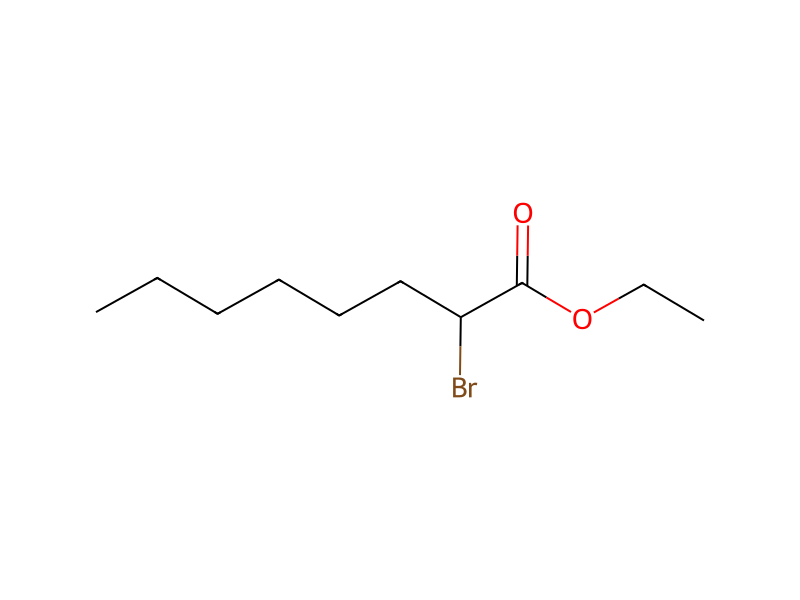
Ethyl 2-bromooctanoate → alpha-[p-(1-Cycloheptenyl)-phenoxy]-octanoic acid ethyl ester
Reaction equation

[C:1]1([C:8]2[CH:13]=[CH:12][C:11]([OH:14])=[CH:10][CH:9]=2)[CH2:7][CH2:6][CH2:5][CH2:4][CH2:3][CH:2]=1.[CH2:15]([O:17][C:18](=[O:27])[CH:19](Br)[CH2:20][CH2:21][CH2:22][CH2:23][CH2:24][CH3:25])[CH3:16]>>[CH2:15]([O:17][C:18](=[O:27])[CH:19]([O:14][C:11]1[CH:10]=[CH:9][C:8]([C:1]2[CH2:7][CH2:6][CH2:5][CH2:4][CH2:3][CH:2]=2)=[CH:13][CH:12]=1)[CH2:20][CH2:21][CH2:22][CH2:23][CH2:24][CH3:25])[CH3:16]Participants
3


Procedure
Analogously to the process described in Example 1, 11.5 g of p-(1-cycloheptenyl)-phenol and 26.4 g of 2-bromooctanoic acid ethyl ester give α-[p-(1-cycloheptenyl)-phenoxy]-octanoic acid ethyl ester as a colourless oil of boiling point 155°-160° C/0.04 mm Hg.
Sources & evidence
- ORD record
- ord-ebfacf40fa95497bab69a97fb92fdb33
- Source dataset
- uspto-grants-1978_09
- Patent number
- US04115416
Reaction notes
Loading…