Thiomorpholine → 6,7-Dimethoxy-2-(thiomorpholin-4-yl)quinazolin-4(3H)-imine
Reaction equation

Cl[C:2]1[N:11]=[C:10]([NH2:12])[C:9]2[C:4](=[CH:5][C:6]([O:15][CH3:16])=[C:7]([O:13][CH3:14])[CH:8]=2)[N:3]=1.[NH:17]1[CH2:22][CH2:21][S:20][CH2:19][CH2:18]1>ClC1C=CC=CC=1>[CH3:14][O:13][C:7]1[CH:8]=[C:9]2[C:4](=[CH:5][C:6]=1[O:15][CH3:16])[N:3]=[C:2]([N:17]1[CH2:22][CH2:21][S:20][CH2:19][CH2:18]1)[N:11]=[C:10]2[NH2:12]Participants
4
Reactant 2

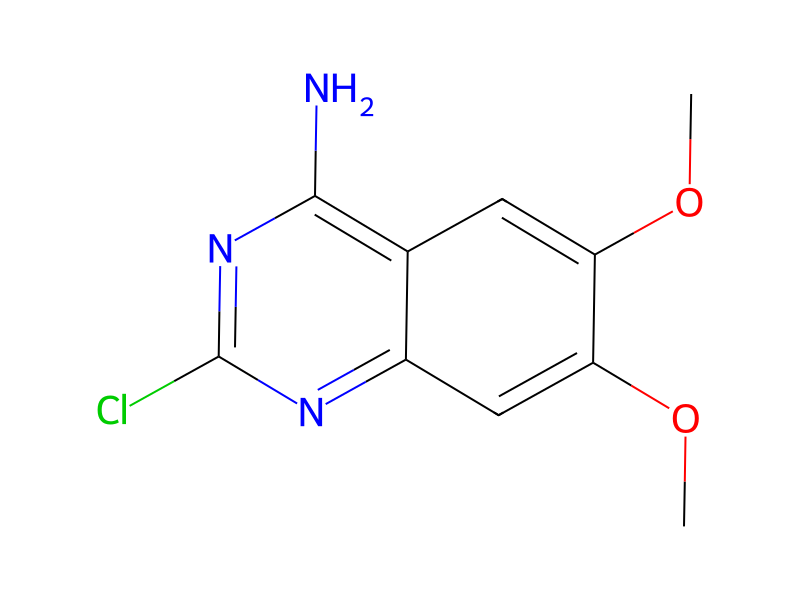
Product 1

Reagents, catalysts & solvents 1

Procedure
A mixture of 8.00 g of 2-chloro-6,7-dimethoxy-4-quinazolinamine and 6.90 g. of thiomorpholine in 80 ml of chlorobenzene was refluxed for 18 hrs. The reaction mixture was cooled to room temperature, and the precipitate was collected. There was deposited 8.00 g (70.2%) of white powder, mp 267°-269°, dec. The product was recrystallized from methanol to give an analytical sample, mp 270°-271°, dec.
Workup
- customthe precipitate was collected
- customThe product was recrystallized from methanol
- customto give an analytical sample, mp 270°-271°, dec.
Sources & evidence
- ORD record
- ord-9e3e47fbaf174921a2ecbaed989ab1c4
- Source dataset
- uspto-grants-1978_09
- Patent number
- US04115565
Reaction notes
Loading…