p-Fluoronitrobenzene → 1-(3-Fluorobenzyloxy)-4-nitro-benzene
Reaction equation

[F:1][C:2]1[CH:3]=[C:4]([CH:7]=[CH:8][CH:9]=1)[CH2:5][OH:6].[OH-].[K+].F[C:13]1[CH:18]=[CH:17][C:16]([N+:19]([O-:21])=[O:20])=[CH:15][CH:14]=1>O>[F:1][C:2]1[CH:3]=[C:4]([CH:7]=[CH:8][CH:9]=1)[CH2:5][O:6][C:13]1[CH:18]=[CH:17][C:16]([N+:19]([O-:21])=[O:20])=[CH:15][CH:14]=1Participants
5
Reactant 3
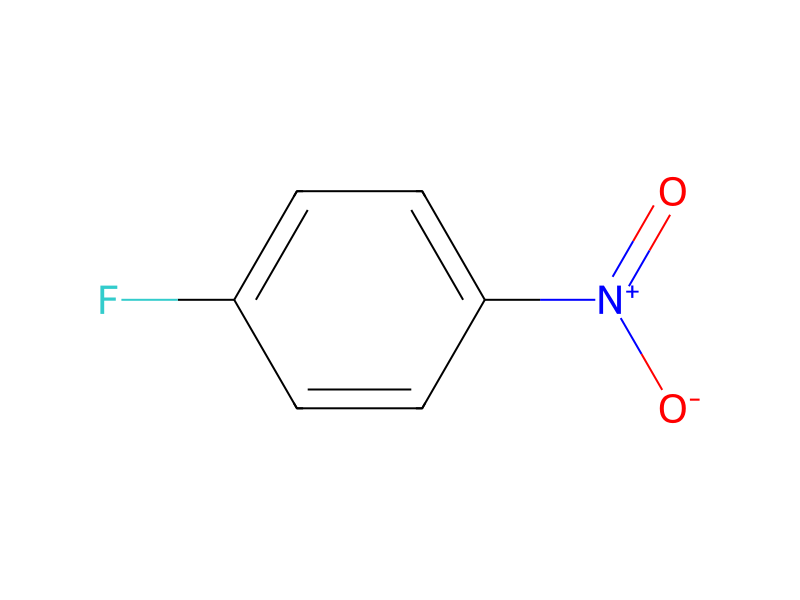


Product 1

Reagents, catalysts & solvents 1

Procedure
A mixture of 5.04 g (40 mmol) 3-fluorobenzyl alcohol and 1.29 g (4 mmol) tris-(dioxa-3,6-heptyl)amine is treated with 2.47 g (44 mmol) of potassium hydroxide. The mixture is stirred at RT for 10 min, then 5.55 g (44 mmol) of 4-fluoro-nitrobenzene is slowly added through a dropping funnel. The mixture is kept for 45 min at 80° C., cooled to RT and diluted with about 75 ml water. Extraction with ethyl acetate and washing with 2M aqueous hydrochloric acid yields a yellowish organic phase, which is dried and evaporated. The residue is recrystallised from methanol to give 6.07 g (61%) of the title compound. Yellow crystals, mp=104–105° C.
Workup
- waitThe mixture is kept for 45 min at 80° C.
- temperaturecooled to RT
- extractionExtraction with ethyl acetate
- washwashing with 2M aqueous hydrochloric acid
- customyields a yellowish organic phase, which
- customis dried
- customevaporated
- customThe residue is recrystallised from methanol
Sources & evidence
- ORD record
- ord-52ae011dae614c82add029e1fb88c0cf
- Source dataset
- uspto-grants-2007_06
- Patent number
- US07235581B2
Reaction notes
Loading…