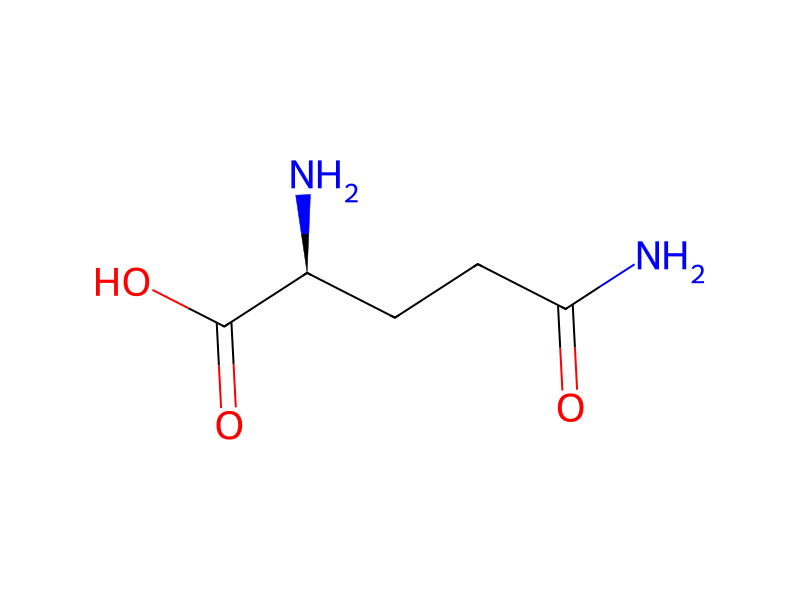
Adenine → L-Glutamine
Reaction equation

N1C(N)=C2C(N=CN2)=NC=1.[NH:11]1[C:20](=[O:21])[C:19]2NC=N[C:15]=2N=C1N.[NH2:22][C@H:23]([C:31]([OH:33])=[O:32])CCCNC(=N)N.N[C@H](C(O)=O)C>>[NH2:22][C@H:23]([C:31]([OH:33])=[O:32])[CH2:15][CH2:19][C:20](=[O:21])[NH2:11]Participants


Procedure
Site-specific mutagenesis was carried out according to standard techniques described by Kunkel (Kunkel T A. Rapid and efficient site-specific mutagenesis without phenotypic selection; Proc Natl Acad Sci USA 1985, 82: 488-492) by inserting an adenine in place of guanine in position 34099 (the mutagenesis was also repeated by inserting an adenine in place of guanine in position 34099, and a guanine in place of adenine in position 34100). Sequencing of the cDNA was carried out for assurance that the mutation was correct and that any new mutations had not been introduced. Expression of the recombinant FIX was obtained using “human embryonic kidney cell line 293” and the methods already reported in the literature (Chang J L, Jin J P, Lollar P, et al. Changing residue 338 in human factor IX from arginine to alanine causes an increase in catalytic activity. J. Biol. Chem. 1998; 273:12089-12094). The recombinant FIX was isolated from the supernatant (culture medium) by means of an immunoaffinity column, as aforedescribed. Briefly, the supernatant of the cell culture was collected every 24 hours for 10 days and conserved at −20° C. For the purification the supernatant was thawed out and benzamidine and EDTA were added to a final concentration of 5 milliMoles and 4 milliMoles respectively. After filtration through a Millipore filter, the supernatant was incubated with fast-flow Sepharose Q resin for 12 hours at 4° C. The resin was then re-equilibrated in Tris, NaCl and benzamidine buffer and loaded onto the column. Elution was undertaken with a 0-60 nM calcium gradient. The eluate was then dialyzed in a Tris-NaCl buffer. The preparation was then applied to the immunoaffinity column following the method described in example 2 (in the “in vitro” expression of the recombinant protein). Starting from the culture medium, the procedure was the same as for the plasma, except for the precipitation procedure using BaCl. The culture medium was centrifuged at 4000 g for 20 minutes then subjected to dialysis in Tris-NaCl and loaded onto the immunoaffinity column at a rate of 0.5 ml/min. The remaining steps were the same as those taken for the plasma.
Workup
- additionhad not been introduced
- customExpression of the recombinant FIX was obtained
- temperaturean increase in catalytic activity
- customThe recombinant FIX was isolated from the supernatant (culture medium) by means of an immunoaffinity column
- customBriefly, the supernatant of the cell culture was collected every 24 hours for 10 days
- customconserved at −20° C
- customFor the purification the supernatant
- additionwere added to a final concentration of 5 milliMoles and 4 milliMoles respectively
- filtrationAfter filtration through a Millipore
- filtrationfilter
- washElution
- customThe eluate was then dialyzed in a Tris-NaCl buffer
- customexcept for the precipitation procedure
- waitThe culture medium was centrifuged at 4000 g for 20 minutes
- customthen subjected to dialysis in Tris-NaCl
Sources & evidence
- ORD record
- ord-fa34d0c4ad9443a1983d38b68c441895
- Source dataset
- uspto-grants-2016_02
- Patent number
- US09249405B2
Reaction notes
Loading…