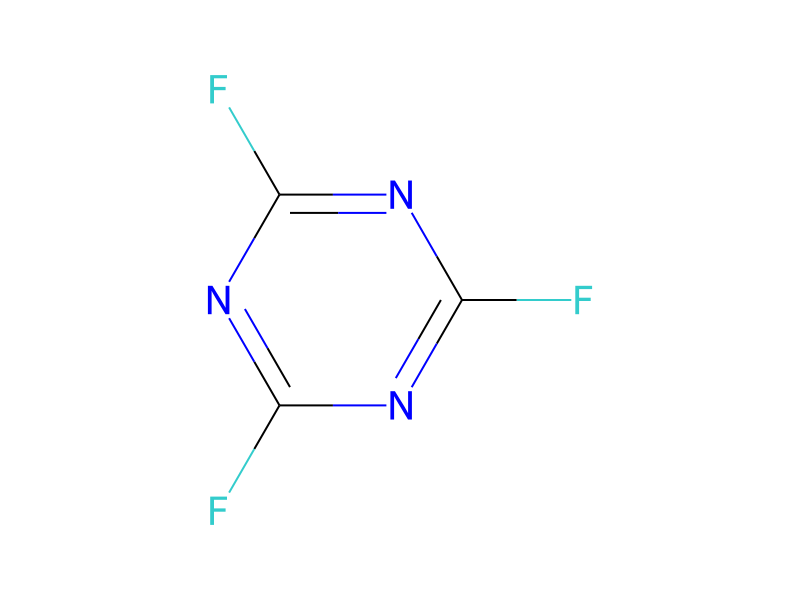
Cyanuric fluoride → HCID 90111611, compound
Reaction equation

[CH3:1][N:2]1[CH2:6][CH2:5][N:4]([CH3:7])[C:3]1=[N:8][OH:9].[N:10]1[C:17](F)=[N:16][C:14](F)=[N:13][C:11]=1F>N1C=CC=CC=1>[CH3:1][N:2]1[CH2:6][CH2:5][N:4]([CH3:7])[C:3]1=[N:8][O:9][C:11]1[N:13]=[C:14]([O:9][N:8]=[C:3]2[N:4]([CH3:7])[CH2:5][CH2:6][N:2]2[CH3:1])[N:16]=[C:17]([O:9][N:8]=[C:3]2[N:4]([CH3:7])[CH2:5][CH2:6][N:2]2[CH3:1])[N:10]=1Participants
4
Reactant 2

Product 1

Reagents, catalysts & solvents 1

Conditions
- Temperature
- 42 °C
Procedure
To a cold (0° C.) solution of 1,3-dimethyl-2-imidazolidinone oxime (prepared according Kitamura, Mitsuru; Chiba, Shunsuke; Narasaka, Koichi, Bulletin of the Chemical Society of Japan (2003), 76(5), 1063-1070) (5.3 g, 0.041 mol) in dry pyridine (25 ml) within 15 minutes is dropwise added cyanuric fluoride (1.49 g, 0.011 mol). The mixture is then heated for 2 h at 42° C. and then stirred for 15 h at room temperature. The pyridine is evaporated under reduced pressure, the residue is chromatographed (silica gel, CH2Cl2—CH3OH 20:1 to 10:1) and the pure fractions are crystallized from ethyl acetate hexane to afford 2.4 g of the title compound as white crystalls, mp. 143-145° C. (decomposition).
Workup
- customThe pyridine is evaporated under reduced pressure
- customthe residue is chromatographed (silica gel, CH2Cl2—CH3OH 20:1 to 10:1)
- customthe pure fractions are crystallized from ethyl acetate hexane
Sources & evidence
- ORD record
- ord-5f433eded7224ae79cb70c78bb0431bc
- Source dataset
- uspto-grants-2016_02
- Patent number
- US09255217B2
Reaction notes
Loading…