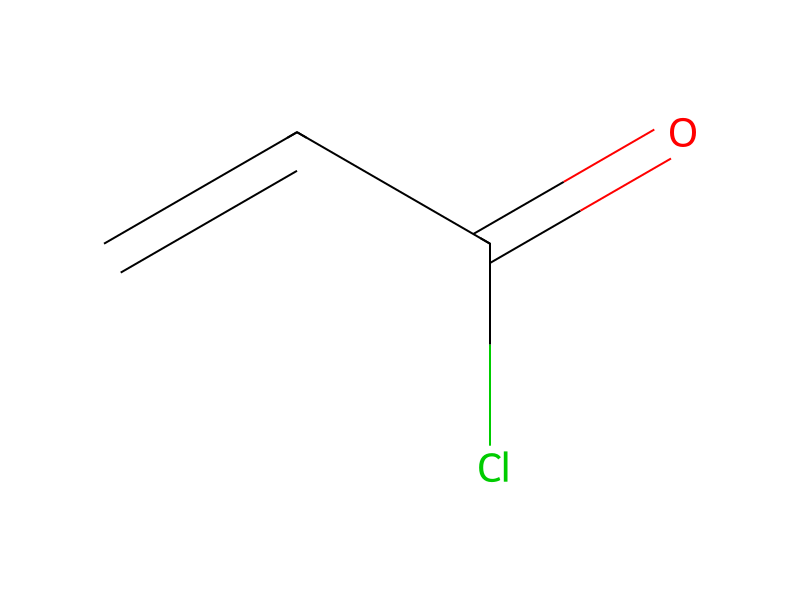
Acryloyl chloride → (S)-N-(1-(6-(5-bromo-1-methyl-2-oxo-1,2-dihydropyridin-3-ylamino)pyridin-2-yloxy)propan-2-yl)acrylamide
Reaction equation

Cl.[NH2:2][C@@H:3]([CH3:22])[CH2:4][O:5][C:6]1[N:11]=[C:10]([NH:12][C:13]2[C:14](=[O:21])[N:15]([CH3:20])[CH:16]=[C:17]([Br:19])[CH:18]=2)[CH:9]=[CH:8][CH:7]=1.[C:23](Cl)(=[O:26])[CH:24]=[CH2:25]>C(Cl)Cl>[Br:19][C:17]1[CH:18]=[C:13]([NH:12][C:10]2[N:11]=[C:6]([O:5][CH2:4][C@@H:3]([NH:2][C:23](=[O:26])[CH:24]=[CH2:25])[CH3:22])[CH:7]=[CH:8][CH:9]=2)[C:14](=[O:21])[N:15]([CH3:20])[CH:16]=1Participants
4
Reactant 2

Product 1

Reagents, catalysts & solvents 1

Procedure
To an ice-cooled mixture of 107c (390 mg, 1.0 mmol) and TEA (0.53 ml, 3.0 mmol) in DCM (20 mL) was added acryloyl chloride (0.23 ml, 2.0 mmol) dropwise. The reaction mixture was stirred at rt for 2 h and quenched with water. The organic layer was separated, dried over Na2SO4, filtered and concentrated. The residue was purified by silica gel chromatography (DCM/MeOH=10/1) to give 107d (284 mg, 70%) as brown solid. MS-ESI: [M+H]+ 409.0
Workup
- customquenched with water
- customThe organic layer was separated
- dry with materialdried over Na2SO4
- filtrationfiltered
- concentrationconcentrated
- customThe residue was purified by silica gel chromatography (DCM/MeOH=10/1)
Sources & evidence
- ORD record
- ord-7dde1bb3de2c46bf9a77bdafa2c58993
- Source dataset
- uspto-grants-2016_02
- Patent number
- US09260415B2
Reaction notes
Loading…