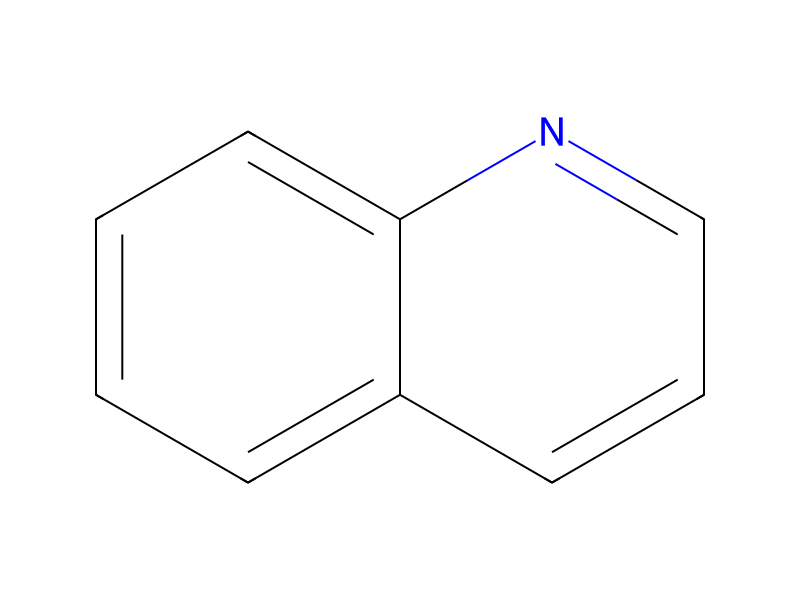
Quinoline → HCID 86702143, compound
Reaction equation

[CH3:1][C:2]([N:6]1[C:18]2[CH:17]=[CH:16][CH:15]=[CH:14][C:13]=2[C:12]2[C:7]1=[CH:8][CH:9]=[CH:10][CH:11]=2)([C:4]#[CH:5])[CH3:3].N1C2C(=CC=CC=2)C=CC=1>[Pd].C1C=CC=CC=1>[CH3:3][C:2]([N:6]1[C:18]2[CH:17]=[CH:16][CH:15]=[CH:14][C:13]=2[C:12]2[C:7]1=[CH:8][CH:9]=[CH:10][CH:11]=2)([CH:4]=[CH2:5])[CH3:1]Participants
5
Reactant 2

Product 1

Reagents, catalysts & solvents 2


Procedure
A mixture of 9-(2-methylbut-3-yn-2-yl)-9H-carbazole (1.600 g, 6.9 mmol), quinoline (0.810 mL, 6.9 mmol), benzene (70.0 mL) and 5% palladium on barium sulfate (0.190 g) was stirred under an atmosphere of hydrogen at room temperature. Once the desired amount of hydrogen was consumed (−45 mins), the reaction was stopped and filtered through Celite and the filtrate concentrated in vacuo. The residue was purified by silica gel chromatography (0-20% methylene chloride/hexanes) to afford the desired product as a colorless oil (1.55 g, 96%). 1H NMR (300 MHz, CDCl3) δ 8.10 (d, 2H, J=7.5 Hz), 7.81 (d, 2H, J=8.4 Hz), 7.35 (t, 2H, J=8.1 Hz), 7.21 (t, 2H, J=7.5 Hz), 6.41 (dd, 1H, J=17.7, 10.5 Hz), 5.32-5.20 (m, 2H), 2.06 (s, 6H).
Workup
- customOnce the desired amount of hydrogen was consumed (−45 mins)
- filtrationfiltered through Celite
- concentrationthe filtrate concentrated in vacuo
- customThe residue was purified by silica gel chromatography (0-20% methylene chloride/hexanes)
Sources & evidence
- ORD record
- ord-04b4f89bdfdb4a40ab8d155d06206e67
- Source dataset
- uspto-grants-2016_02
- Patent number
- US09265772B2
Reaction notes
Loading…