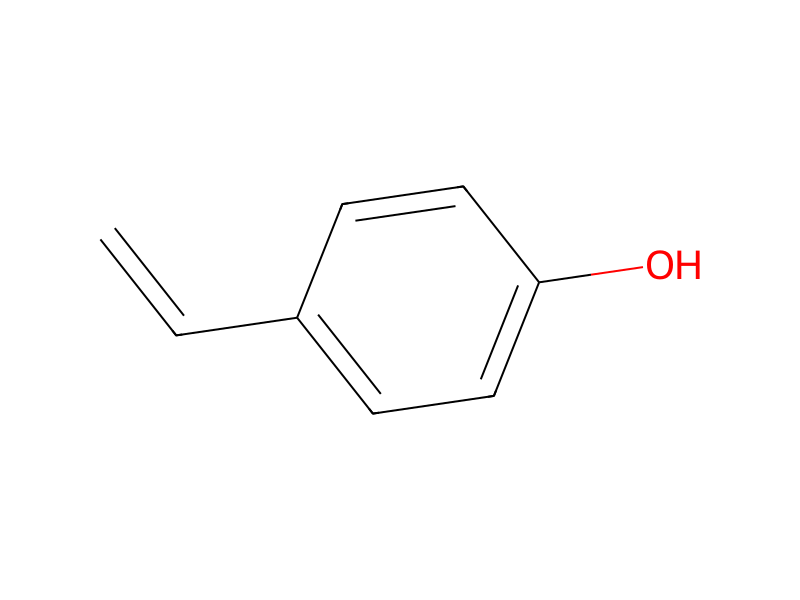
tert-Butyl methacrylate → 4-Vinylphenol
Reaction equation

[C:1]1([OH:7])[CH:6]=[CH:5][CH:4]=[CH:3][CH:2]=1.[CH3:8][CH2:9]OCC.[CH3:13][C:14]([C:16]([O:18][C:19]([CH3:22])([CH3:21])[CH3:20])=[O:17])=C>>[C:19]([O:18][C:16]([O:7][C:1]1[CH:6]=[CH:5][C:4]([CH:8]=[CH2:9])=[CH:3][CH:2]=1)=[O:17])([CH3:22])([CH3:21])[CH3:20].[OH:7][C:1]1[CH:6]=[CH:5][C:4]([CH:13]=[CH2:14])=[CH:3][CH:2]=1Participants



Procedure
For example, as resist materials used in the case of using a light source capable of oscillating KrF excimer laser beams or deep ultraviolet light, there have been developed dissolution-inhibiting type resist materials comprising a resin having high transmittance for light of 248.4 nm and a photosensitive compound having a diazodiketo group in the molecule (for example, Japanese Patent Unexamined Publication Nos. 1-80944, 1-54048, 1-155338, 1-155339 and 1-188852, and Y. Tani et al., SPIE's 1989 Sympo., 1086-03, etc.). However, these dissolution-inhibiting type resist materials, in common with one another, have a low sensitivity and hence cannot be used in the case of employment of deep ultraviolet light or KrF excimer laser beams which requires a highly sensitive resist material. On the other hand, for reduction of the exposure energy (enhancement of the sensitivity), there has been proposed recently a chemical amplified type resist material in which an acid generated by exposure to light is used as a catalyst [H. Ito et al., Polym. Eng. Sci., 23, 1012 (1983)]. On such chemical amplified type resist materials, various reports have been presented [for example, H. Ito et al., U.S. Pat. No. 4,491,628 (1985); J. V. Crivello, U.S. Pat. No. 4,603,101 (1986); W. R. Brunsvolt et al., SPIE's 1989 Sympo., 1086-40; T. Neeman et al., SPIE's 1989 Sympo., 1086-01; and Japanese Patent Unexamined Publication No. 62-115440 (U.S. Pat. No. 4,603,101)]. Such chemical amplified type resist materials, however, involve the following problems. When there is used in them a phenol ether type resin such as poly(4-tert-butoxycarbonyloxystyrene), poly(4-tert-butoxycarbonyloxy-α-methylstyrene), poly(4-tert-butoxystyrene), poly(4-tert-butoxy-α-methylstyrene) or the like, all of the chemical amplified type resist materials have poor thermal stability and are disadvantageous in that because of their low adhesive properties to a substrate, film peeling tends to occur during development, so that no satisfactory pattern can be obtained. When there is used a carboxylic acid ester type resin such as poly(tert-butyl 4-vinylbenzoate) or the like, the chemical amplified type resist materials are insufficient in light-transmitting properties near 248.4 nm because of the aromatic ring. When there is used a poly(tert-butyl methacrylate) or the like, the thermal stability and dry etching durability of this resin are poor. As resist materials free from the above defects, there have recently been reported a resist material obtained by use of a copolymer of p-tert-butoxycarbonyloxystyrene and p-hydroxystyrene (Japanese Patent Unexamined Publication No. 2-209977 (EP 366,590)), a resist material obtained by use of a copolymer of p-tetrahydropyranyloxystyrene and p-hydroxystyrene (Japanese Patent Unexamined Publication No. 2-19847 (U.S. Pat. No. 5,069,997, U.S. Pat. No. 5,118,585)), a resist material obtained by use of a copolymer of p-tert-butoxystyrene and p-hydroxystyrene (Japanese Patent Unexamined Publication No. 2-62544), etc. However, when a pattern formation is carried out using such a resist material, there takes place a loss of critical dimension of pattern with a time delay between exposure and post-exposure bake (hereinafter referred to as "PEB"). Therefore, even if a pattern can be formed in a remarkably short time, a good pattern formation cannot be expected in a practical production wherein a considerable time is required from the light exposure to PEB. Thus, such resist materials are disadvantageous in that they are of little practical use. Further, the resist materials obtained by use of the above-mentioned polymers or copolymers are, in common with one another, disadvantageous in that the difference in dissolution rate for an alkali developer between light exposed areas and non-exposed areas of the resist material is small, resulting in making resolution ability insufficient.
Workup
- customcan be obtained
- customthe like, the thermal stability and dry etching durability of this resin
Sources & evidence
- ORD record
- ord-10d68773605f48ebbf1a7e7261e1c357
- Source dataset
- uspto-grants-1997_05
- Patent number
- US05627006
Reaction notes
Loading…