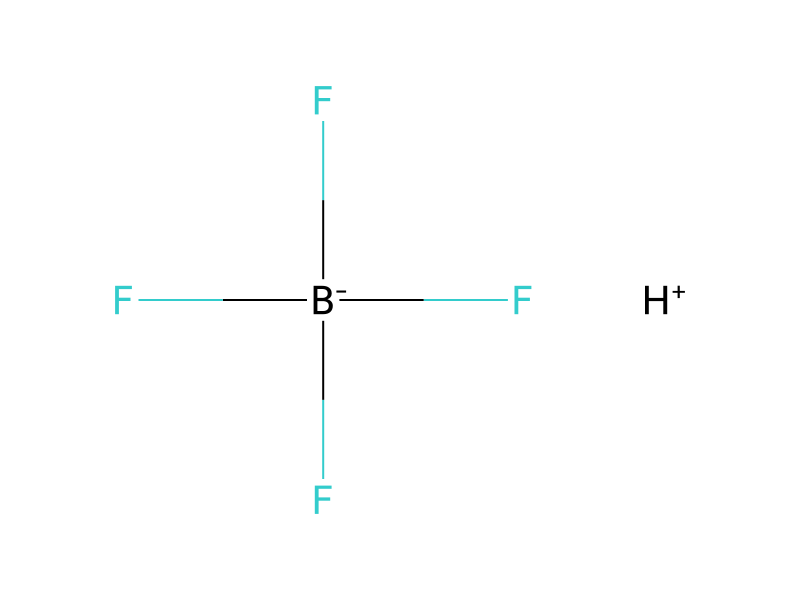
Tetrafluoroboric acid → 3-Bromo-6-fluoro-2,4-dimethylpyridine
Reaction equation

N[C:2]1[CH:7]=[C:6]([CH3:8])[C:5]([Br:9])=[C:4]([CH3:10])[N:3]=1.N([O-])=O.[Na+].[H+].[B-](F)(F)(F)[F:17]>O>[Br:9][C:5]1[C:4]([CH3:10])=[N:3][C:2]([F:17])=[CH:7][C:6]=1[CH3:8]Participants
5
Reactant 3


Product 1

Reagents, catalysts & solvents 1

Conditions
- Temperature
- 90 °C
Procedure
To a suspension of 2-amino-5-bromo-4,6-dimethylpyridine (4.02 g, 20.0 mmol) in HBF4 (48% in water, 15 mL) cooled in an ice bath was added a solution of NaNO2 (1.73 g, 25.0 mmol) in water (5 mL). The reaction mixture turned clear, and 10 min later a precipitate was formed. The precipitate was collected by filtration, dried under vacuum and added to hot heptane (100 mL) pre-heated at 90° C. After heated at 90° C. for 2 h the mixture was cooled to room temperature and filtered. The filtrate was concentrated under vacuum to afford 3-bromo-2,4-dimethyl-6-fluoropyridine as a pale yellow solid (1.45 g, 36%). 1H NMR (CDCl3): δ 2.43 (s, 3H), 2.61 (s, 3H), 6.66 (d, 1H, J=3.0 Hz). 19F NMR (CDCl3): δ 3.24.
Workup
- temperaturecooled in an ice bath
- custom10 min later a precipitate was formed
- filtrationThe precipitate was collected by filtration
- customdried under vacuum
- additionadded to hot heptane (100 mL)
- temperatureAfter heated at 90° C. for 2 h the mixture
- temperaturewas cooled to room temperature
- filtrationfiltered
- concentrationThe filtrate was concentrated under vacuum
Sources & evidence
- ORD record
- ord-855c69ff66e3428d9430d67f6fe34fc3
- Source dataset
- uspto-grants-2009_03
- Patent number
- US07498346B2
Reaction notes
Loading…