HuagongsheHuagongshe Chemistry Print Report · For research reference only
HRID 1789757Generated: October 28, 2026
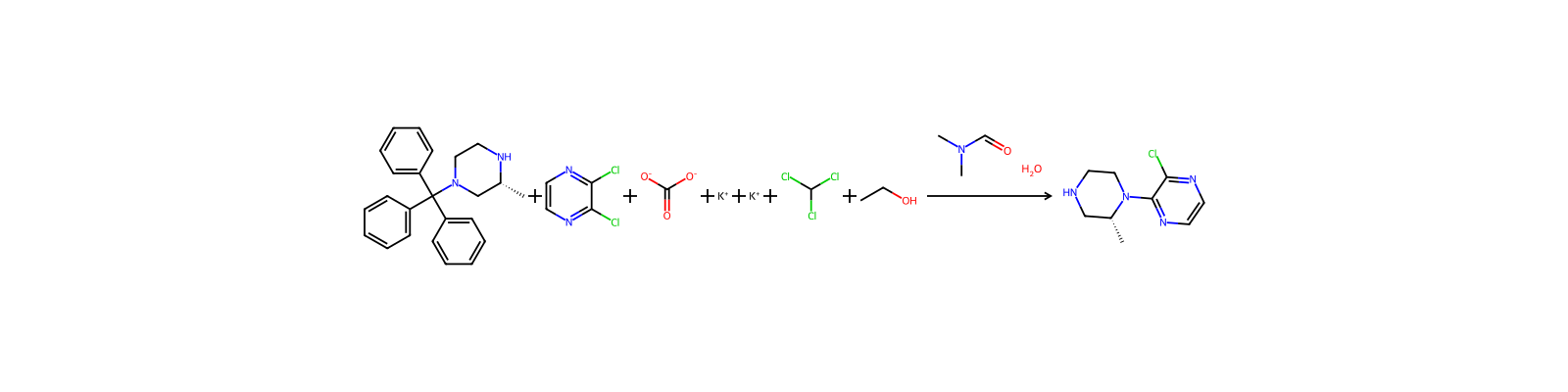
Potassium Carbonate → (R)-2-Chloro-3-(2-methylpiperazin-1-YL)pyrazine
https://huagongshe.com/reaction/1789757
Participants
| Role | Name | HCID | Charge |
|---|
| Reactant | Potassium Carbonate | HCID 11430 | — |
| Reactant | 2,3-Dichloropyrazine | HCID 78575 | — |
| Reactant | (R)-4-N-Trityl-2-methyl piperazine | HCID 2760887 | — |
| Reactant | Chloroform ethanol | HCID 21889567 | — |
| Solvent | Water | HCID 962 | — |
| Solvent | Dimethylformamide | HCID 6228 | — |
| Product | (R)-2-Chloro-3-(2-methylpiperazin-1-YL)pyrazine | HCID 9992195 | 66% |
Reaction Steps
A mixture of the product obtained in Step 1 above, 2,3-dichloropyrazine (154 g, 1.00 mmol) and K2CO3 (160 g, 1.20 mol) in DMF (1 L) was heated at 110° C. for 20 h with vigorous stirring. (TLC monitoring system: CHCl3: EtOH (20:1); silica). The mixture was cooled and poured slowly into water (6 L) with stirring. The solid was collected, washed with water, dried, dissolved in CHCl3 (1 L), diluted with n-heptane (1 L), and filtered through SiO2. Solvents were evaporated off. The resulting oil was dried under vacuum (3 mm/50° C., 30 min) to remove the DMF. The oil was dissolved in hot ethanol (1 L.), and HCl (10% aqueous solution, 300 mL) was added slowly. Trityl carbinol began to crystallize out after 10 min. After 30 min, the formed trityl carbinol was filtered off and the ethanol was evaporated. The aqueous solution was extracted by ether (2×200 mL) and made basic by addition of K2CO3 to pH 12. The alkaline layer was extracted with CHCl3 (3×200 mL). The combined organic layers were dried (K2CO3) and concentrated to give 140 g (66%) of the title compound.
Provenance & Evidence
| DOI | 10.6084/m9.figshare.5104873.v1 |
|---|
| Patent number | US07071180B2 |
|---|
| Source dataset | uspto-grants-2006_07 |
|---|
| ORD ID | ord-fe13deb2f8f244b88eeb50d6b6084223 |
|---|
| Source note | uspto-grants-2006_07 |
|---|