Ethyl bromoacetate → HCID 20750053, compound
Reaction equation

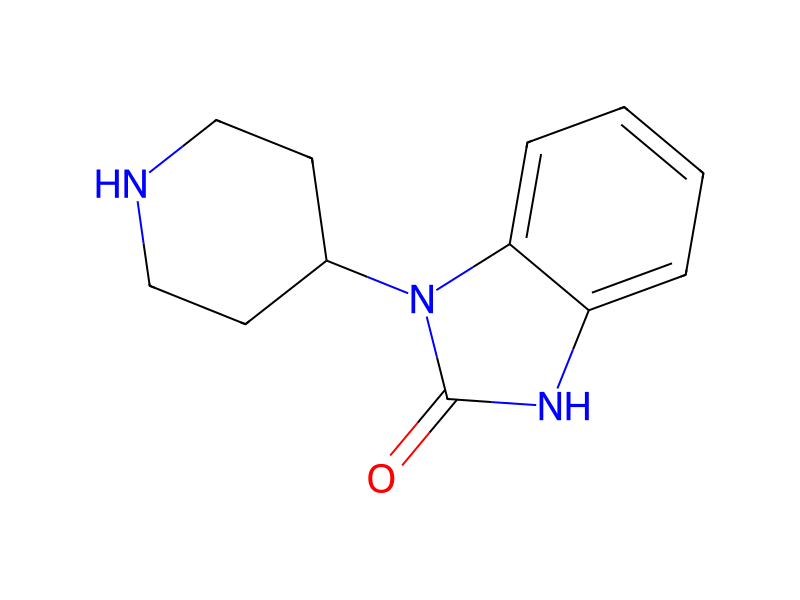
[O:1]=[C:2]1[N:6]([CH:7]2[CH2:12][CH2:11][N:10]([CH2:13][C:14]([OH:16])=[O:15])[CH2:9][CH2:8]2)[C:5]2[CH:17]=[CH:18][CH:19]=[CH:20][C:4]=2[NH:3]1.O=C1N(C2CCNCC2)[C:25]2C=CC=C[C:24]=2N1.BrCC(OCC)=O>C(#N)C>[O:1]=[C:2]1[N:6]([CH:7]2[CH2:12][CH2:11][N:10]([CH2:13][C:14]([O:16][CH2:24][CH3:25])=[O:15])[CH2:9][CH2:8]2)[C:5]2[CH:17]=[CH:18][CH:19]=[CH:20][C:4]=2[NH:3]1Participants




Procedure
Compounds of formula A in which Z=2,3-dihydro-2-oxo-1H-benzimidazol-1-yl and L=(N-methylene)piperidin-4-yl are prepared from β-aminotetralins (VII) or phenethylamines (XI) and [4-(2-keto-1-benzimidazolinyl)piperidin-1-yl]acetic acid (Schemes 6–7). For example, 4-(2-keto-1-benzimidazolinyl)piperidine is reacted with a bromoacetic acid ester, such as ethyl bromoacetate, in the presence of an amine base, such as diusopropylethylamine, in an inert solvent such as acetonitrile, at a temperature ranging from ambient temperature to reflux, to afford ethyl [4-(2-keto-1-benzimidazolinyl)piperidin-1-yl]acetate. This ester is subjected to hydrolysis under basic conditions, for example, by treatment with sodium hydroxide in an alcoholic solution such as aqueous methanol, to yield, upon acidification with an inorganic or organic acid such as hydrochloric or acetic acid for example, [4-(2-keto-1-benzimidazolinyl)piperidin-1-yl]acetic acid. This carboxylic acid is reacted directly with βaminotetralins (VII) or phenethylamines (XI), in the presence of an amine base, under peptide coupling conditions described above, to afford benzimidazolinones (XVII) and (XVIII) of formula A in which Y=carbonyl and L=(N-methylene)piperidin-4-yl (Schemes 6–7).
Workup
- customranging from ambient temperature
- temperatureto reflux
Sources & evidence
- ORD record
- ord-e6e98be830eb44eab480e0c3b34cfda2
- Source dataset
- uspto-grants-2006_07
- Patent number
- US07071195B2
Reaction notes
Loading…