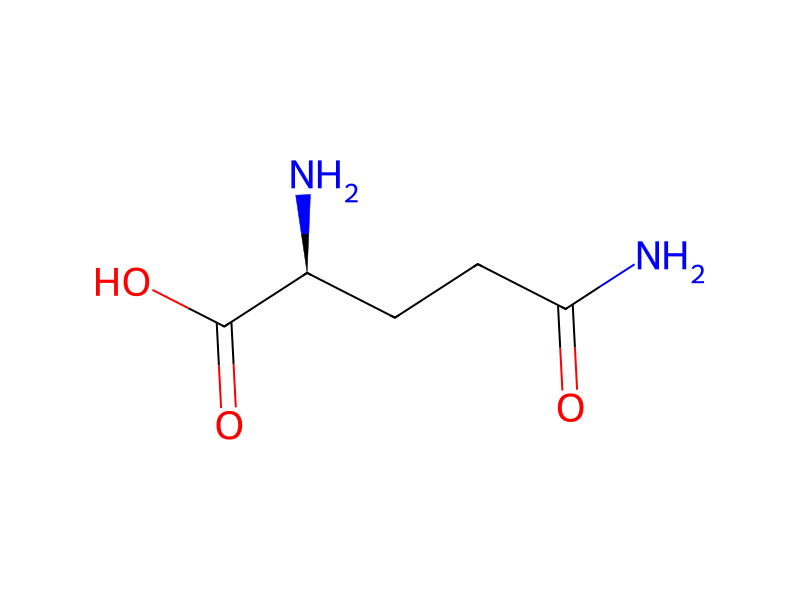
L-Glutamine → Pyridazine
Reaction equation

NN.[NH2:3][C@H:4]([C:10]([OH:12])=[O:11])[CH2:5][CH2:6][C:7](=[O:9])[NH2:8]>>[N:8]1[CH:7]=[CH:6][CH:5]=[CH:4][N:3]=1.[NH2:3][C@H:4]([C:10]([OH:12])=[O:11])[CH2:5][CH2:6][C:7](=[O:9])[NH2:8]Participants


Procedure
FIG. 2 depicts a schematic diagram 200 depicting the treatment of hydrazine waste to glutamine or a derivative thereof, in accordance with a preferred embodiment of the present invention. The hydrogenization of pyridazine using 5% Pd/C can provide glutamine in a 45% yield. Although this pyridazine is not easily biodegraded, the present inventors believe that glutamine can be utilized as a plant nutrient or that it is easily biodegradable. Glutamine can be specifically utilized as a source of energy and for nucleotide synthesis by all rapidly dividing cells. Thus, rather than acting as an environmental hazard, glutamine or a derivative can actually benefit plants exposed to it during a hydrazine remediation process, as described herein.
Sources & evidence
- ORD record
- ord-16183485148f4b48b77ba0ac5d33f916
- Source dataset
- uspto-grants-2006_07
- Patent number
- US07074959B2
Reaction notes
Loading…