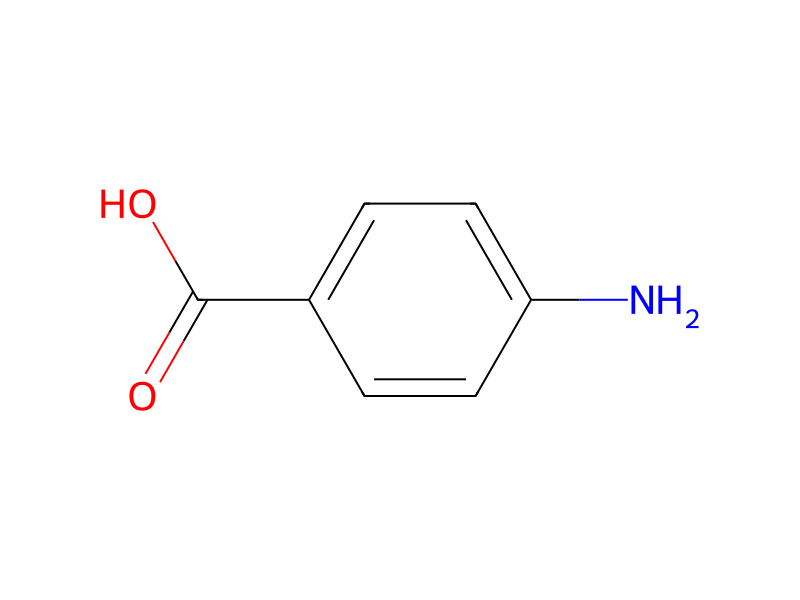
4-Aminobenzoic Acid → 6-Benzothiazolecarboxylic acid, 2-amino-
Reaction equation

[NH2:1][C:2]1[CH:10]=[CH:9][C:5]([C:6]([OH:8])=[O:7])=[CH:4][CH:3]=1.[S-:11][C:12]#[N:13].[K+].BrBr>CC(O)=O.O>[NH2:13][C:12]1[S:11][C:3]2[CH:4]=[C:5]([C:6]([OH:8])=[O:7])[CH:9]=[CH:10][C:2]=2[N:1]=1Participants
Reactant 3


Product 1

Reagents, catalysts & solvents 2


Conditions
- Temperature
- 25 °C
Procedure
A solution of 4-aminobenzoic acid (1.37 g, 14 mmol) in AcOH (16 mL) may be added with potassium thiocyanate (3.9 g, 40 mmol) and may be stirred for 15 minutes. A solution of bromine (0.5 mL, 10 mmol) in AcOH (6 mL) may then be added slowly into the reaction mixture in water bath, where the temperature may be maintained at about 25° C. The resulting mixture may be stirred overnight. The mixture may then be filtered, and the pale yellow precipitate may then be further recrystallized with the minimal volume of aqueous hydrochloric acid (6 M). A pale yellow product of formula (2) may be collected with the following characterization: 1H NMR (CD3OD, 500 MHz): δ 4.96 (2H, brs), 7.58 (1H, d, J=8.0 Hz), 8.14 (1H, dd, J=8.5 Hz and 1.5 Hz), 8.47-8.47 (1H, m); 13C NMR (CDCl3): δ 12.1, 23.7, 54.6, 85.0, 85.1, 122.5, 123.9, 127.9, 128.3, 132.7, 151.9, 155.3, 168.0, 178.7.
Workup
- stirringThe resulting mixture may be stirred overnight
- filtrationThe mixture may then be filtered
- customthe pale yellow precipitate may then be further recrystallized with the minimal volume of aqueous hydrochloric acid (6 M)
- customA pale yellow product of formula (2) may be collected with the following characterization
Sources & evidence
- ORD record
- ord-ea8db082c3824647b8fe800c17c00ca9
- Source dataset
- uspto-grants-2013_01
- Patent number
- US08344007B2
Reaction notes
Loading…