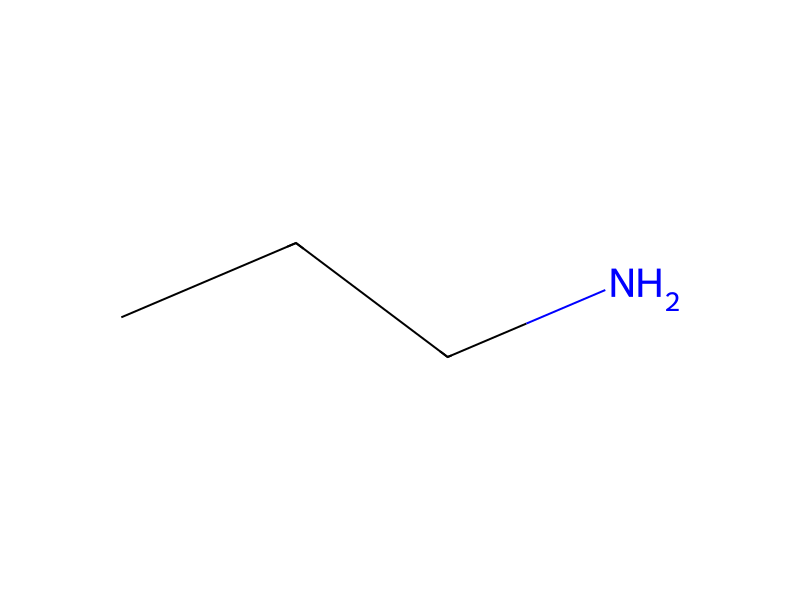
Propylamine → 2-Propylamino-5-methoxytetralin
Reaction equation

[CH3:1][CH2:2][CH2:3][N:4]([C@@H:12]1[CH2:17][C:16]2[CH:18]=[CH:19][CH:20]=[C:21]([OH:22])[C:15]=2[CH2:14][CH2:13]1)CCC1SC=CC=1.Cl.[CH3:24]OC1C=CC=C2C=1CCC(=O)C2.CCCN>C(O)(=O)C.[H][H].O=[Pt]=O>[CH3:24][O:22][C:21]1[CH:20]=[CH:19][CH:18]=[C:16]2[C:15]=1[CH2:14][CH2:13][CH:12]([NH:4][CH2:3][CH2:2][CH3:1])[CH2:17]2Participants
6
Reactant 3


Product 1

Reagents, catalysts & solvents 2


Procedure
Another process for preparing racemic rotigotine hydrochloride, which is disclosed in U.S. Pat. No. 4,564,628, is shown in Scheme 2 below. 5-methoxy-2-tetralon (Compound I) is reacted with 3-propylamine in acetic acid and H2/PtO2 to obtain 1,2,3,4-tetrahydro-5-methoxy-N-propyl-2-naphthaleneamine (Compound VI). This intermediate then is reacted either with 2-thienylacetic acid in presence of borane trimethylamine complex in xylene or with 2-thienylacetyl chloride and lithium aluminum hydride to obtain 1,2,3,4-tetrahydro-5-methoxy-N-propyl-N-[2-(2-thienyl)ethyl]-2-naphthaleneamine (Compound IV). Finally, this intermediate is reacted with boron tribromide, then with HCl, to form the racemic rotigotine hydrochloride (Compound V).
Sources & evidence
- ORD record
- ord-0d0612c424ce4582b6c18d53a6b08a3c
- Source dataset
- uspto-grants-2013_01
- Patent number
- US08344165B2
Reaction notes
Loading…