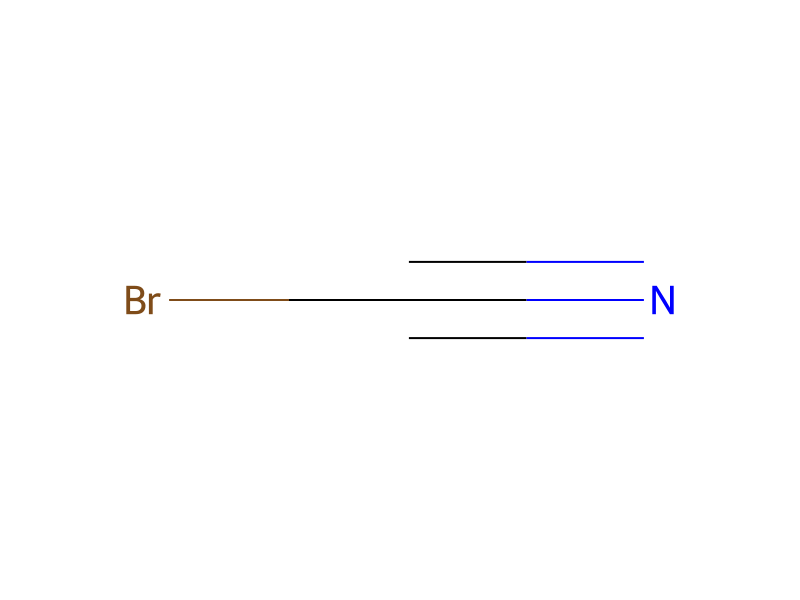
Cyanogen Bromide → HCID 178507355, compound
Reaction equation

[NH2:1][C:2]1[CH:3]=[C:4]([NH2:9])[C:5]([NH2:8])=[CH:6][CH:7]=1.[N:10]#[C:11]Br>C(O)C>[NH2:1][C:2]1[CH:7]=[CH:6][C:5]2[NH:8][C:11]([NH2:10])=[N:9][C:4]=2[CH:3]=1Participants
Reactant 2

Product 1

Reagents, catalysts & solvents 1

Conditions
- Temperature
- 60 °C
Procedure
Alternate synthesis of a substituted 2-aminobenzimidazole. A mixture of 5-fluoro-2-nitro-phenylamine (1 mmol), an amine (2 mmol) in THF (20 mL) is heated at about 60° C. overnight. After cooling the mixture to room temperature, the reaction mixture is concentrated. The crude material is purified on a silica gel column to yield a 5-amino-2-nitro-phenylamine. The 5-amino-2-nitro-phenylamine (1.0 mmol) is dissolved in an ethyl acetate-methanol mixture (about 1:1, 10 mL) in a round-bottom flask. To this solution Pd—C is added, and the mixture is stirred under a hydrogen atmosphere, while monitoring the reaction with thin-layer chromatography (TLC). After TLC shows completion of the reaction, the solution is filtered on celite and then washed with methanol and concentrated to obtain a 4-amino-benzene-1,2-diamine. The 4-amino-benzene-1,2-diamine (1 mmol) is dissolved in ethanol and CNBr (1.5 mmol) is added. The resulting dark brown solution is heated at 60° C. for 30 minutes. Thereafter, the mixture is cooled to room temperature, and the solvent is evaporated. Then, the mixture is co-evaporated with toluene about two times to obtain a 5-amino-1H-benzoimidazol-2-ylamine as a hydrobromide salt. The reaction scheme below provides an illustration that accompanies this textual description.
Workup
- temperatureThereafter, the mixture is cooled to room temperature
- customthe solvent is evaporated
Sources & evidence
- ORD record
- ord-8b5ac3c6b96649c396ade4f760938aa5
- Source dataset
- uspto-grants-2013_01
- Patent number
- US08350039B2
Reaction notes
Loading…