2-Octyldodecanol → Dodecanoic acid, 2-octyl-
Reaction equation

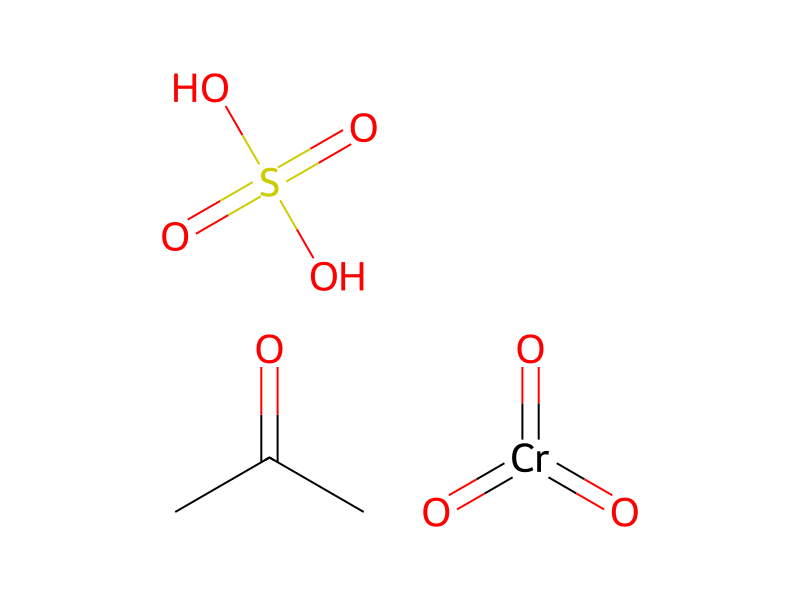
[CH2:1]([CH:9]([CH2:12][CH2:13][CH2:14][CH2:15][CH2:16][CH2:17][CH2:18][CH2:19][CH2:20][CH3:21])[CH2:10][OH:11])[CH2:2][CH2:3][CH2:4][CH2:5][CH2:6][CH2:7][CH3:8].CC(C)=[O:24].OS(O)(=O)=O.O=[Cr](=O)=O>CC(C)=O>[CH2:1]([CH:9]([CH2:12][CH2:13][CH2:14][CH2:15][CH2:16][CH2:17][CH2:18][CH2:19][CH2:20][CH3:21])[C:10]([OH:24])=[O:11])[CH2:2][CH2:3][CH2:4][CH2:5][CH2:6][CH2:7][CH3:8]Participants
Reactant 2

Product 1

Reagents, catalysts & solvents 1

Procedure
To the reactor as in Example 1, decanol-1 (300 g) was charged to the reactor and ZnO (2 g), KOH (6 g), CaO (5 g) and Cu Bronze (1.5 g) were added. The above reaction mixture was heated at 200° C. for 6 h to complete the reaction. The reaction mixture was filtered and purified by distillation to get 2-octyl-1-dodecanol (250 g). 2-octyl-1-dodecanol (250 g) was reacted with Jones reagent (200 ml) in acetone (200 ml) to get 2-octyl-1-dodecanoic acid. 2-Octyl-1-dodecanoic acid (200 g) was again charged to the reactor and subsequently, methanol (200 g) and sulfuric acid (6.0 g) were added slowly to the reactor with stirring. The reaction mixture was refluxed till completion of the reaction. The reaction mixture was passed through basic alumina to get rid of residual catalyst. The catalyst free mixture was fractionated to separate un-reacted methanol and synthetic diesel. Prepared synthetic diesel was evaluated for fuel properties and results were tabulated.
Sources & evidence
- ORD record
- ord-201dea1abbbd49689beae11fb2b1aa22
- Source dataset
- uspto-grants-2013_01
- Patent number
- US08353972B2
Reaction notes
Loading…