Pyridine → HCID 58537232, compound
Reaction equation

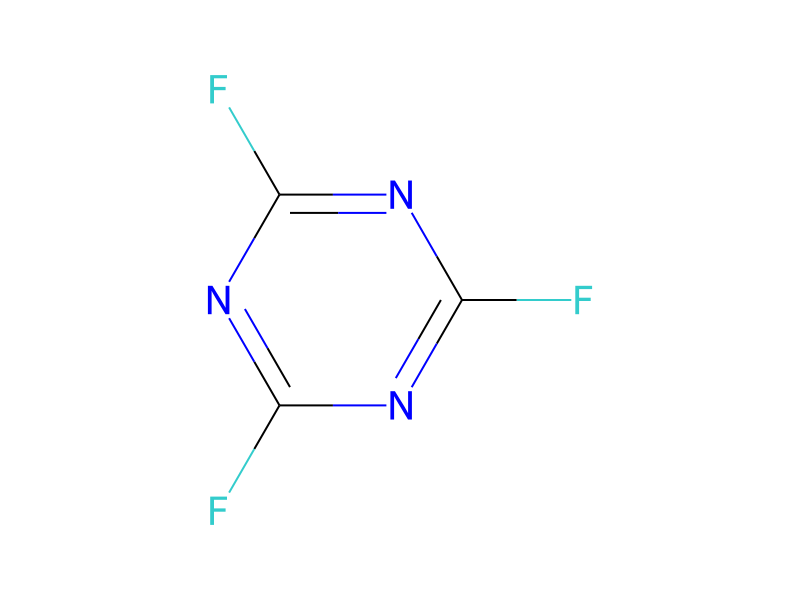
[CH3:1][O:2][C:3]([C:5]1[C:6]([C:13]2[CH:18]=[CH:17][CH:16]=[CH:15][CH:14]=2)=[N:7][O:8][C:9]=1[C:10](O)=[O:11])=[O:4].N1C=CC=CC=1.N1C(F)=NC(F)=NC=1[F:27]>C(Cl)Cl>[F:27][C:10]([C:9]1[O:8][N:7]=[C:6]([C:13]2[CH:18]=[CH:17][CH:16]=[CH:15][CH:14]=2)[C:5]=1[C:3]([O:2][CH3:1])=[O:4])=[O:11]Participants
Reactant 3


Product 1

Reagents, catalysts & solvents 1

Procedure
To a solution of 4-(methoxycarbonyl)-3-phenylisoxazole-5-carboxylic acid (100 mg, 0.405 mmol) and pyridine (0.039 mL, 0.485 mmol) in DCM (4 mL) at rt was added cyanuric fluoride (0.041 mL, 0.485 mmol) and the reaction mixture was stirred at rt for 2 hr. The reaction mixture was diluted with dichloromethane (20 ml) and washed with ice-cold 0.5N HCl (20 mL). The aqueous layer was extracted with DCM (10 mL) and the combined organic layers were dried (MgSO4), filtered and concentrated to afford methyl 5-(fluorocarbonyl)-3-phenylisoxazole-4-carboxylate (100 mg, 0.401 mmol, 99% yield) as a colorless oil. The compound was found to react readily with methanol and was characterized as the methyl ester. HPLC retention time=1.59 minutes (PHENOMENEX® Luna 4.6×30 mm S-5 ODS column) eluting with 10-90% aqueous methanol+0.1% TFA over a 2 minute gradient. MS: (M+H)=262.15 (methyl ester).
Workup
- washwashed with ice-cold 0.5N HCl (20 mL)
- extractionThe aqueous layer was extracted with DCM (10 mL)
- dry with materialthe combined organic layers were dried (MgSO4)
- filtrationfiltered
- concentrationconcentrated
Sources & evidence
- ORD record
- ord-0375e9e33f2243b69114f44f31c70ad6
- Source dataset
- uspto-grants-2013_01
- Patent number
- US08354398B2
Reaction notes
Loading…