Linoleic Acid → Linolenic Acid
Reaction equation

[C:1]([OH:20])(=[O:19])[CH2:2][CH2:3][CH2:4][CH2:5][CH2:6][CH2:7][CH2:8]/[CH:9]=[CH:10]\[CH2:11]/[CH:12]=[CH:13]\[CH2:14][CH2:15][CH2:16][CH2:17][CH3:18].C(O)(=O)CCCC/C=C\C/C=C\C/C=C\CCCCC>>[CH3:18][CH2:17]/[CH:16]=[CH:15]\[CH2:14]/[CH:13]=[CH:12]\[CH2:11]/[CH:10]=[CH:9]\[CH2:8][CH2:7][CH2:6][CH2:5][CH2:4][CH2:3][CH2:2][C:1]([OH:20])=[O:19]Participants
3
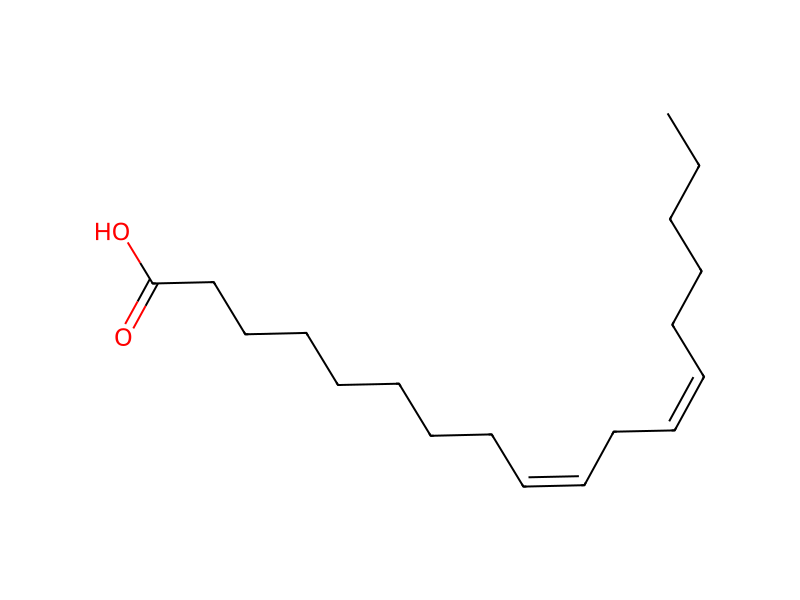


Procedure
The increase in the conversion rate of PUFAs, which had been observed for the total extracts, was clearly also monitored in the neutral lipids. As regards the feeding of linoleic acid (FIGS. 25 A and B), a 2-fold increase in the conversion of linoleic acid into γ-linolenic acid (18:3 Δ6,9,12) and a 3-fold increase in the 20:2 Δ9,12 content was observed. The feeding of linolenic acid (FIG. 26, C and D) gave similar data (conversion of 18:3 into 18:4 3-fold, of 18:3 into 20:3 3-fold).
Workup
- temperaturea 3-fold increase in the 20:2 Δ9,12 content
Sources & evidence
- ORD record
- ord-3473af661a6b421cbde1b1742b202b4c
- Source dataset
- uspto-grants-2013_01
- Patent number
- US08354569B2
Reaction notes
Loading…