Acetone → (3E)-4-(2,6-Dichlorophenyl)-3-buten-2-one
Reaction equation

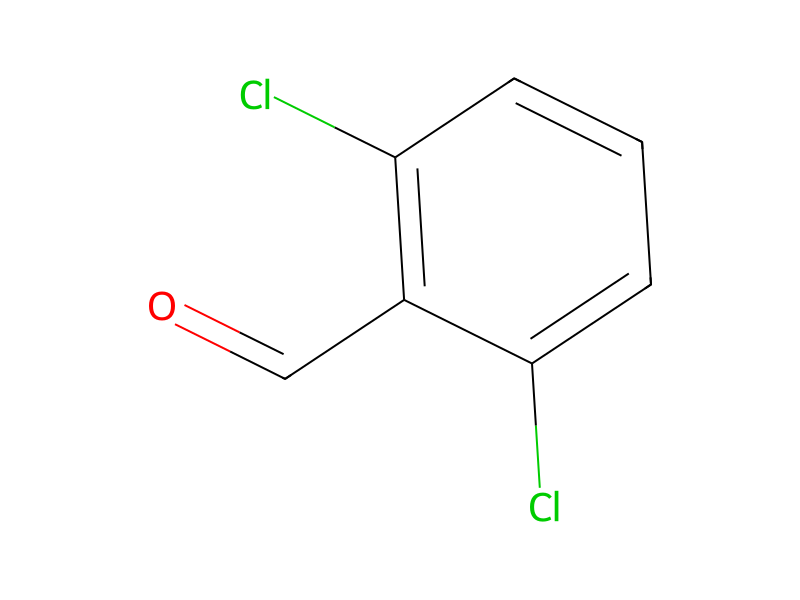
[Cl:1][C:2]1[CH:9]=[CH:8][CH:7]=[C:6]([Cl:10])[C:3]=1[CH:4]=O.[CH3:11][C:12]([CH3:14])=[O:13].[OH-].[Na+]>O>[Cl:1][C:2]1[CH:9]=[CH:8][CH:7]=[C:6]([Cl:10])[C:3]=1/[CH:4]=[CH:11]/[C:12](=[O:13])[CH3:14]Participants
Reactant 3


Product 1

Reagents, catalysts & solvents 1

Conditions
- Temperature
- 0 °C
Procedure
A round bottom flask equipped with magnetic stirrer and nitrogen inlet was charged with 2,6-dichlorobenzaldehyde (5.0 g, 28.57 mmol), acetone (42 ml, 0.571 mol) and water (20 ml). The mixture was cooled to 0° C. and a solution of sodium hydroxide (1.14 g, 28.57 mmol) in water (20 ml) was added drop wise during 1 hour to the vigorous stirred suspension. The reaction mixture was stirred for an additional 0.5 hour. The reaction mixture was concentrated in vacuo, poured onto 10% HCl (100 ml) and extracted with ethyl acetate (3×50 ml). Combined organic layers were dried over anhydrous sodium sulfate. The solvent was removed in vacuo and the residue was purified by flash chromatography over silica gel (350 g) (eluent: n-hexane/ethyl acetate 10:1) to afford 6.0 g (97% of theory) of (E)-4-(2,6-dichloro-phenyl)-but-3-en-2-one in form of a pale yellow oil.
Workup
- customA round bottom flask equipped with magnetic stirrer and nitrogen inlet
- concentrationThe reaction mixture was concentrated in vacuo
- additionpoured onto 10% HCl (100 ml)
- extractionextracted with ethyl acetate (3×50 ml)
- dry with materialCombined organic layers were dried over anhydrous sodium sulfate
- customThe solvent was removed in vacuo
- customthe residue was purified by flash chromatography over silica gel (350 g) (eluent: n-hexane/ethyl acetate 10:1)
Sources & evidence
- ORD record
- ord-9d3b6ac7b2d64fa6a302af5a7cf639ef
- Source dataset
- uspto-grants-2013_01
- Patent number
- US08357635B2
Reaction notes
Loading…