Sodium Carbonate → 6-(4-FLUOROPHENYL)INDOLE
Reaction equation

Br[C:2]1[CH:10]=[C:9]2[C:5]([CH:6]=[CH:7][NH:8]2)=[CH:4][CH:3]=1.[F:11][C:12]1[CH:17]=[CH:16][C:15](B(O)O)=[CH:14][CH:13]=1.C(=O)([O-])[O-].[Na+].[Na+]>C1(C)C=CC=CC=1.C(O)C.C1C=CC([P]([Pd]([P](C2C=CC=CC=2)(C2C=CC=CC=2)C2C=CC=CC=2)([P](C2C=CC=CC=2)(C2C=CC=CC=2)C2C=CC=CC=2)[P](C2C=CC=CC=2)(C2C=CC=CC=2)C2C=CC=CC=2)(C2C=CC=CC=2)C2C=CC=CC=2)=CC=1>[F:11][C:12]1[CH:17]=[CH:16][C:15]([C:2]2[CH:10]=[C:9]3[C:5]([CH:6]=[CH:7][NH:8]3)=[CH:4][CH:3]=2)=[CH:14][CH:13]=1Participants

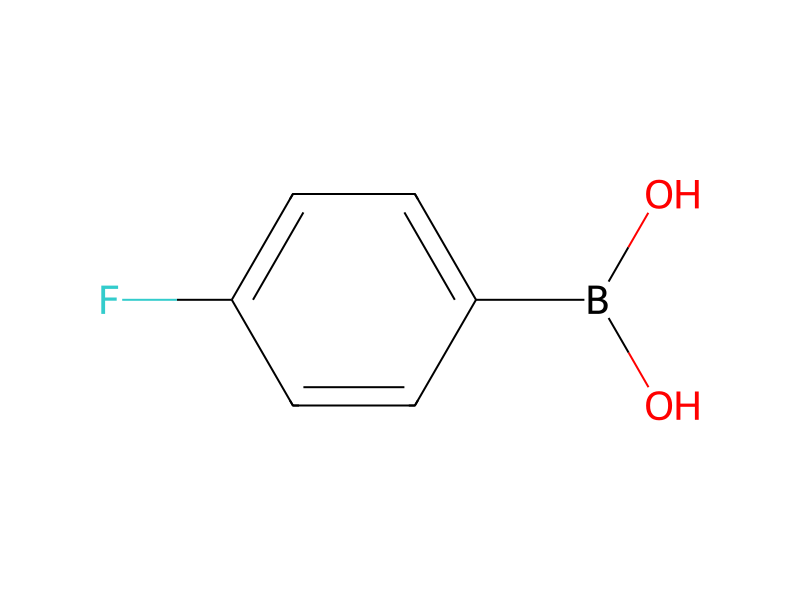





Conditions
- Temperature
- 90 °C
Procedure
Step 1 A mixture of 6-bromo-1H-indole (0.25 g, 1.275 mmol), 4-fluorophenylboronic acid (0.178 g, 1.275 mmol), and 2 M aqueous sodium carbonate (2.0 mL, 4.00 mmol) in toluene (10 mL) and ethanol (2.500 mL) was purged with argon and treated with tetrakis(triphenylphosphine)palladium (0.074 g, 0.064 mmol). The mixture was heated at 90° C. After 17 h, the mixture was cooled to rt and partitioned between water and EtOAc. The organic phase was dried and concentrated. The residue was purified by column chromatography (eluting with a gradient from 95:5 to 60:40 hexane-EtOAc) to provide 6-(4-fluorophenyl)-1H-indole as a white solid (175.5 mg, 65%). 1H NMR (400 MHz, DMSO-d6) δ 11.17 (1 H, br. s.), 7.65-7.71 (2 H, m), 7.56-7.62 (2 H, m), 7.37 (1 H, t, J=2.9 Hz), 7.22-7.31 (3 H, m), 6.44 (1 H, t, J=2.0 Hz). Mass spectrum m/z 212.2 (M+H)+.
Workup
- customwas purged with argon
- temperaturethe mixture was cooled to rt
- custompartitioned between water and EtOAc
- customThe organic phase was dried
- concentrationconcentrated
- customThe residue was purified by column chromatography (
- washeluting with a gradient from 95:5 to 60:40 hexane-EtOAc)
Sources & evidence
- ORD record
- ord-f7b6effe5b9f4c3090b8ce544423651a
- Source dataset
- uspto-grants-2013_01
- Patent number
- US08362065B2
Reaction notes
Loading…