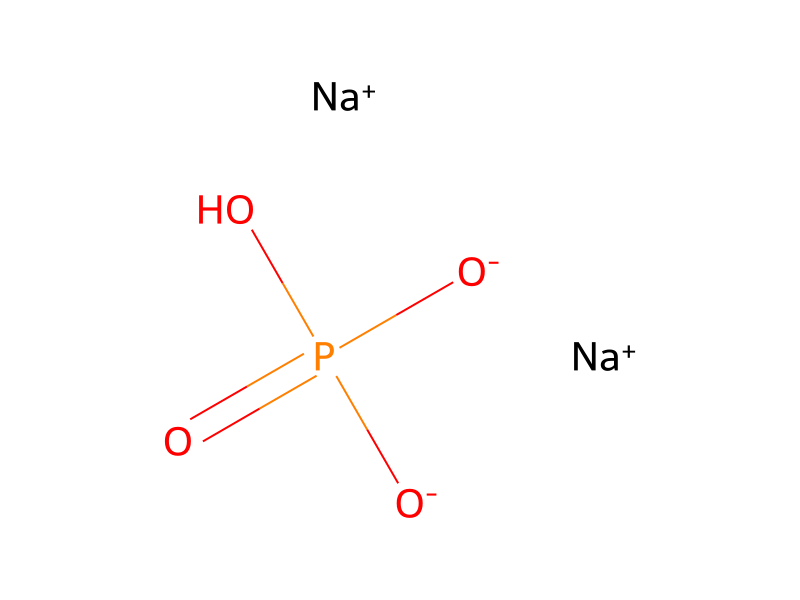
Sodium Phosphate, Dibasic → HCID 86588241, compound
Reaction equation

[C:1]1(/[CH:11]=[CH:12]\[CH3:13])[C:10]2[C:5](=[CH:6][CH:7]=[CH:8][CH:9]=2)[CH:4]=[CH:3][CH:2]=1.P([O-])([O-])(O)=[O:15].[Na+].[Na+]>C(Cl)Cl>[C:1]1([C@H:11]2[O:15][C@H:12]2[CH3:13])[C:10]2[C:5](=[CH:6][CH:7]=[CH:8][CH:9]=2)[CH:4]=[CH:3][CH:2]=1Participants
Reactant 2

Product 1

Reagents, catalysts & solvents 1

Conditions
- Temperature
- 6 °C
Procedure
(ref. E. Jacobsen, el al; JACS 1991, 7064.) The (Z)-1-(1-naphthyl)-propene (2.06 g, 0.012 mol) was dissolved in methylene chloride, and (R, R)-Jacobsen's catalyst (0.168 g) was added, then cooled to 6° C., and a bleach solution (10 mL, buffered to pH=11.3 with disodium hydrogen phosphate) was added. After 6 h at 6° C., the layers were separated, and the aqueous layer washed with ether. The combined organic layers were washed with water, then brine, dried over magnesium sulfate, filtered and rotovapped. The crude product was chromatographed on silica using 5% ether/pentane, to give the desired (1R, 2S)-1-(1-naphthyl)-1-propene oxide (0.421 g). NMR (CDCl3) 8.1-7.7 (3H, m), 7.6-7.3 (4H, m), 4.6-4.5 (1H, m), 3.7-3.5 (1H, m), 1.0 (3H, d, J=5.3 Hz).
Workup
- customthe layers were separated
- washthe aqueous layer washed with ether
- washThe combined organic layers were washed with water
- dry with materialbrine, dried over magnesium sulfate
- filtrationfiltered
- customThe crude product was chromatographed on silica using 5% ether/pentane
Sources & evidence
- ORD record
- ord-39c025390e3049ebb2a9f103d830d556
- Source dataset
- uspto-grants-2005_04
- Patent number
- US06875765B2
Reaction notes
Loading…