Trimethyl orthovalerate → 7-bromo-2-butyl-1-isobutyl-1H-imidazo[4,5-c]quinoline
Reaction equation

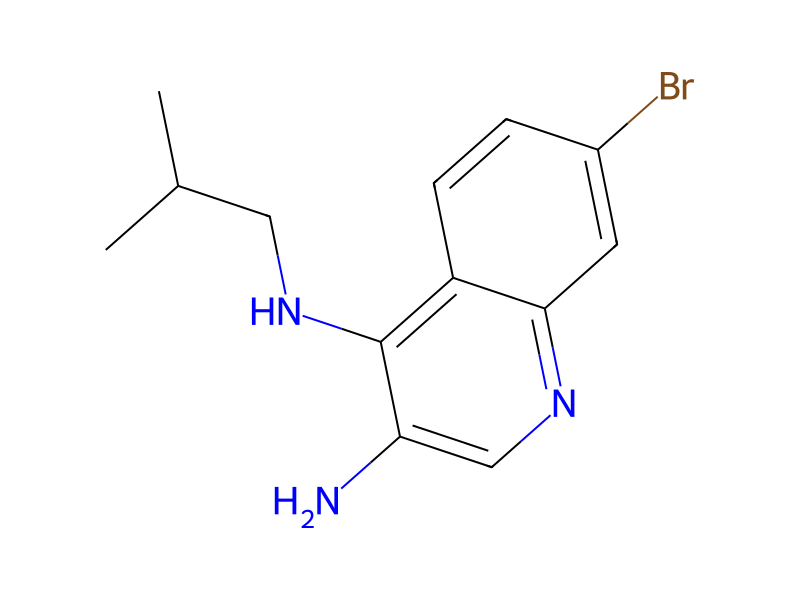
[Br:1][C:2]1[CH:11]=[C:10]2[C:5]([C:6]([NH:13][CH2:14][CH:15]([CH3:17])[CH3:16])=[C:7]([NH2:12])[CH:8]=[N:9]2)=[CH:4][CH:3]=1.[C:18](OC)(OC)(OC)[CH2:19][CH2:20][CH2:21][CH3:22]>Cl.N1C=CC=CC=1.C1(C)C=CC=CC=1>[Br:1][C:2]1[CH:3]=[CH:4][C:5]2[C:6]3[N:13]([CH2:14][CH:15]([CH3:17])[CH3:16])[C:18]([CH2:19][CH2:20][CH2:21][CH3:22])=[N:12][C:7]=3[CH:8]=[N:9][C:10]=2[CH:11]=1Participants
5




Procedure
7-Bromo-N4-isobutylquinoline-3,4-diamine (39.4 g of crude material), trimethyl orthovalerate (32 g, 0.20 mol), and pyridine hydrochloride (0.31 g, 2.7 mmol) were combined with anhydrous toluene (500 mL) and heated to reflux for 30 min. The reaction was cooled to room temperature, concentrated, and the residue was purified by chromatography on silica gel (75% ethyl acetate in hexane to 100% ethyl acetate gradient) to afford 21.2 g of 7-bromo-2-butyl-1-isobutyl-1H-imidazo[4,5-c]quinoline as a yellow solid.
Workup
- temperatureheated
- temperatureto reflux for 30 min
- concentrationconcentrated
- customthe residue was purified by chromatography on silica gel (75% ethyl acetate in hexane to 100% ethyl acetate gradient)
Sources & evidence
- ORD record
- ord-2ce973852df043cb9ceeab06a2d77bfa
- Source dataset
- uspto-grants-2009_10
- Patent number
- US07598382B2
Reaction notes
Loading…