Triphenylphosphine → 1-(2-Morpholin-2-ylethyl)-3-phenyl-1,3-dihydro-2,1,3-benzothiadiazole 2,2-dioxide
Reaction equation

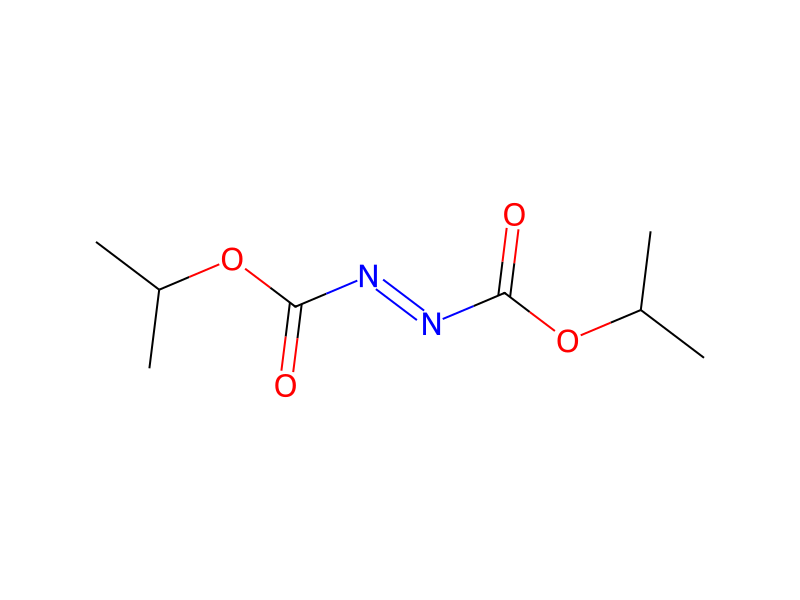
[C:1]1([N:7]2[C:11]3[CH:12]=[CH:13][CH:14]=[CH:15][C:10]=3[NH:9][S:8]2(=[O:17])=[O:16])[CH:6]=[CH:5][CH:4]=[CH:3][CH:2]=1.C1(P(C2C=CC=CC=2)C2C=CC=CC=2)C=CC=CC=1.O[CH2:38][CH2:39][CH:40]1[O:45][CH2:44][CH2:43][N:42](C(OC(C)(C)C)=O)[CH2:41]1.CC(OC(/N=N/C(OC(C)C)=O)=O)C>C1COCC1>[NH:42]1[CH2:43][CH2:44][O:45][CH:40]([CH2:39][CH2:38][N:9]2[C:10]3[CH:15]=[CH:14][CH:13]=[CH:12][C:11]=3[N:7]([C:1]3[CH:2]=[CH:3][CH:4]=[CH:5][CH:6]=3)[S:8]2(=[O:16])=[O:17])[CH2:41]1Participants
Reactant 4



Product 1

Reagents, catalysts & solvents 1

Procedure
To a solution of 1-phenyl-1,3-dihydro-2,1,3-benzothiadiazole2,2-dioxide (0.2 g, 0.8 mmol) in THF (10 mL) was added triphenylphosphine (0.26 g, 1 mmol), tert-butyl 2-(2-hydroxyethyl)morpholine-4-carboxylate (0.2 g, 0.9 mmol) and DIAD (0.2 g, 1 mmol) at 0° C. The mixture was allowed to warm to ambient temperature overnight then concentrated and chromatographed on silica gel (0 to 40% EtOAC in hexane). The resulting mostly pure carbamate was dissolved in dichloromethane (10 mL) and treated with HCL (4 mL, 4M in dioxane). The resulting salt was chromatographed on silica (0 to 100% of (7N NH3/MeOH) in dichloromethane) giving the desired product as a clear oil (0.23 g, 80%). HRMS: calcd for C18H21N3O3S+H+, 360.1376; found (ESI, [M+H]+), 360.1377.
Workup
- concentrationthen concentrated
- customchromatographed on silica gel (0 to 40% EtOAC in hexane)
- dissolutionThe resulting mostly pure carbamate was dissolved in dichloromethane (10 mL)
- additiontreated with HCL (4 mL, 4M in dioxane)
- customThe resulting salt was chromatographed on silica (0 to 100% of (7N NH3/MeOH) in dichloromethane)
Sources & evidence
- ORD record
- ord-925fb8f9c4614bedbce2345bbef1660d
- Source dataset
- uspto-grants-2009_10
- Patent number
- US07601722B2
Reaction notes
Loading…