Nitric Acid → 3,3'-Diaminobenzidine
Reaction equation

[N+:1]([C:4]1[CH:5]=[C:6]([C:14]2[CH:23]=[CH:22][C:17]([NH:18]C(=O)C)=[C:16]([N+:24]([O-])=O)[CH:15]=2)[CH:7]=[CH:8][C:9]=1[NH:10]C(=O)C)([O-])=O.[N+]([O-])(O)=O>C1(C2C=CC(N)=CC=2)C=CC(N)=CC=1.C(OC(=O)C)(=O)C.C(O)(=O)C>[NH2:1][C:4]1[CH:5]=[C:6]([C:14]2[CH:23]=[CH:22][C:17]([NH2:18])=[C:16]([NH2:24])[CH:15]=2)[CH:7]=[CH:8][C:9]=1[NH2:10]Participants
6
Reactant 2


Product 1

Reagents, catalysts & solvents 3


Procedure
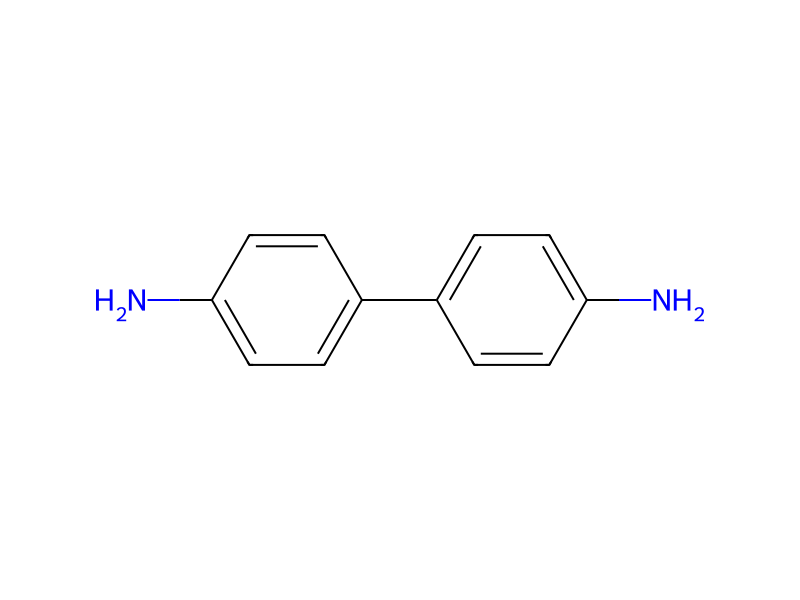
That is, amino groups in benzidine are first protected by N-acetylation with acetic anhydride, and the resulting acetylated compound is then converted into 3,3′-dinitro-N,N′-diacetylbenzidine by nitration. For example, this nitration is performed with concentrated nitric acid in a mixture of acetic anhydride and acetic acid. 3,3′-Dinitro-N,N′-diacetylbenzidine is treated with a base to remove the acetyl groups and then treated with tin (II) chloride in hydrochloric acid to reduce the nitro groups to yield 3,3′,4,4′-tetraaminobiphenyl (Scheme 1).
Workup
- customto remove the acetyl groups
- additiontreated with tin (II) chloride in hydrochloric acid
Sources & evidence
- ORD record
- ord-a0ef56b3459d450684c7015e01f86b43
- Source dataset
- uspto-grants-2009_10
- Patent number
- US07601873B2
Reaction notes
Loading…