Sodium Hydroxide → 8-((3-Bromo-1H-pyrrolo[2,3-b]pyridin-1-yl)sulfonyl)quinoline
Reaction equation

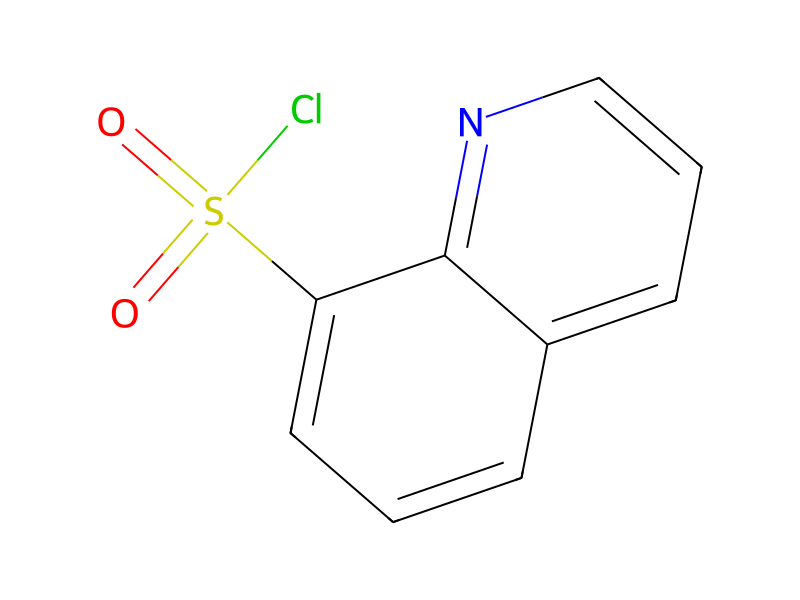
[Br:1][C:2]1[C:10]2[C:5](=[N:6][CH:7]=[CH:8][CH:9]=2)[NH:4][CH:3]=1.[OH-].[Na+].[N:13]1[C:22]2[C:17](=[CH:18][CH:19]=[CH:20][C:21]=2[S:23](Cl)(=[O:25])=[O:24])[CH:16]=[CH:15][CH:14]=1>CCCC[N+](CCCC)(CCCC)CCCC.[Br-].ClCCl>[Br:1][C:2]1[C:10]2[C:5](=[N:6][CH:7]=[CH:8][CH:9]=2)[N:4]([S:23]([C:21]2[CH:20]=[CH:19][CH:18]=[C:17]3[C:22]=2[N:13]=[CH:14][CH:15]=[CH:16]3)(=[O:24])=[O:25])[CH:3]=1Participants
Reactant 3


Product 1

Reagents, catalysts & solvents 2


Procedure
Into a round bottom flask was added 3-bromo-7-azaindole (3, 1.18 g, 5.99 mmol) and tetra-N-butylammonium bromide (193 mg, 0.600 mmol), and 5.0 M sodium hydroxide (15.4 mL). 8-Quinoline-sulfonyl chloride (1.64 g, 7.19 mmol) in dichloromethane (5.9 mL) was added dropwise at room temperature. After a few hours, all starting materials were gone. After 30 mL of dichlormethane was added, two layers were separated. The aqueous layer was washed with dichloromethane. The combined organic layers were washed with 1 M sodium bicarbonate, water, and brine and dried over anhydrous sodium sulfate. The crude material was concentrated under reduced pressure and was purified by column chromatography (55-80% ethyl acetate in hexane) to yield the desired product as a light yellow colored solid (44, 1.72 g, 4.43 mmol). MS(ESI) [M+H+]+=389.4.
Workup
- waitAfter a few hours
- customtwo layers were separated
- washThe aqueous layer was washed with dichloromethane
- washThe combined organic layers were washed with 1 M sodium bicarbonate, water, and brine
- dry with materialdried over anhydrous sodium sulfate
- concentrationThe crude material was concentrated under reduced pressure
- customwas purified by column chromatography (55-80% ethyl acetate in hexane)
Sources & evidence
- ORD record
- ord-0b3e465459264aa1bd63f7e87f825df2
- Source dataset
- uspto-grants-2009_10
- Patent number
- US07605168B2
Reaction notes
Loading…