Trifluoroacetic acid → 7-Trifluoromethyl-1,2,3,5-tetrahydro-[4,1]benzothiazepine
Reaction equation

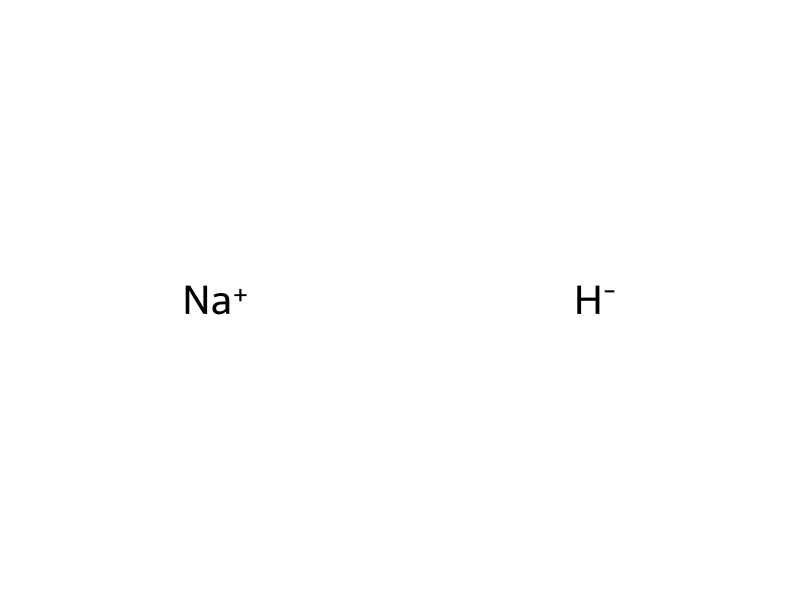
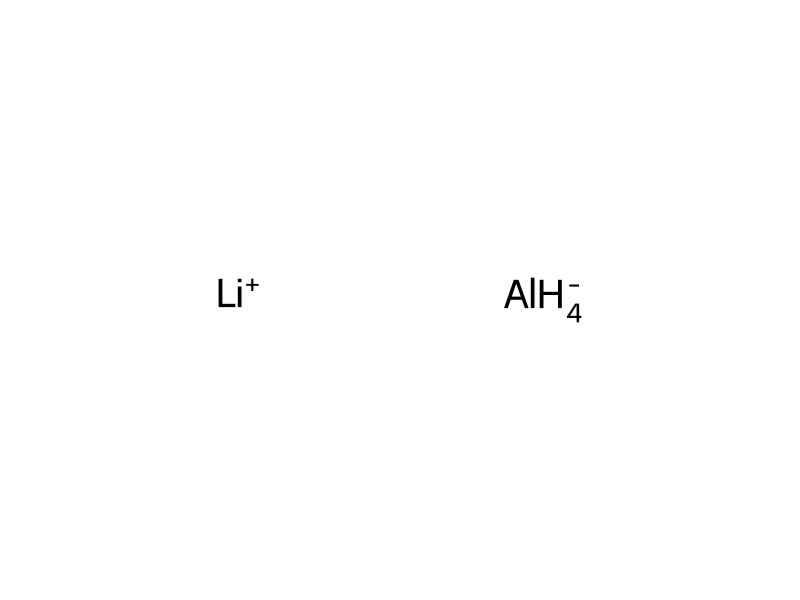
C(OC)(=O)CS.[H-].[Na+].FC(F)(F)C(O)=O.[F:16][C:17]([F:31])([F:30])[C:18]1[CH:19]=[CH:20][C:21]2[NH:27][C:26](=O)[CH2:25][S:24][CH2:23][C:22]=2[CH:29]=1.FC(F)(F)C1C=CC(N)=CC=1.[AlH4-].[Li+]>>[F:31][C:17]([F:16])([F:30])[C:18]1[CH:19]=[CH:20][C:21]2[NH:27][CH2:26][CH2:25][S:24][CH2:23][C:22]=2[CH:29]=1Participants
Reactant 6



Product 1

Procedure
This reaction is carried out by any method which makes it possible to convert from a ketone to an alcohol. The procedure is generally carried out by means of sodium borohydride, in an alcohol such as methanol or ethanol, at a temperature of between 0 and 25 degrees C. The synthesis method described above and in patent application WO99/05147 involves obtaining the methanesulfonate of dioxide-6,6 of 2-imino-9-trifluoromethyl-4,5-dihydro-2H,7H-thiazolo[3,4,5-de][4,1]benzothiazepine in 9 steps from the 4-trifluoromethyl-aniline according to the following reaction scheme (I) In order to obtain the product 2, the product 1 is protected according to standard methods with a BOC group with dicarbonate di tert-butyl in reflux THF. The product 2 is transformed in product 3 with tert butyl lithium, which is highly unstable. In order to obtain the product 4, the methyl function is brominated with N-bromosuccinimide. In order to obtain the intermediate 5, the sulfurated chain is reacted with methyl thioglycolate in the presence of sodium hydride. This intermediate is cyclised in the presence of trifluoroacetic acid. The amide function of the intermediate 6, i.e., 7-trifluoromethyl-1,5-dihydro-3H-[4,1]benzothiazepine-2-one, is reduced to the amine in the presence of lithium tetrahydroaluminate to obtain the intermediate 7, i.e., 7-trifluoromethyl-1,2,3,5-tetrahydro-[4,1]benzothiazepine. The third cycle is added in the presence of potassium and bromine thiocyanate in acetic acid. The key intermediate 8, i.e., 2-imino-9-trifluoromethyl-4,5-dihydro-2H,7H-thiazolo[3,4,5-de][4,1]benzothiazepine, is thus obtained in 7 steps. The intermediate 8 is reacted to obtain the final methanesulfonate product, 2-imino-9-trifluoromethyl-4,5-dihydro-2H,7H-thiazolo[3,4,5-de][4,1]benzothiazepine-6,6-dioxide, as well as the corresponding (R,S) 2-imino-9-trifluoromethyl-4,5-dihydro-2H,7H-thiazolo[3,4,5-de][4,1]benzothiazepine-6-oxide as well as its enantiomers. A recently developed improved synthesis directed to optimizing each of these steps is summarized in reaction scheme (II) below. In particular, this improved synthesis reduces the number of synthesis steps and makes use of other synthesis intermediates, as well as industrial reagents. It also allows a one-step cyclization and, at the same time, avoids the need for purification by chromatography.
Sources & evidence
- ORD record
- ord-ab4bfdd1f7d349309c2166b64f701c14
- Source dataset
- uspto-grants-2006_05
- Patent number
- US07041661B2
Reaction notes
Loading…