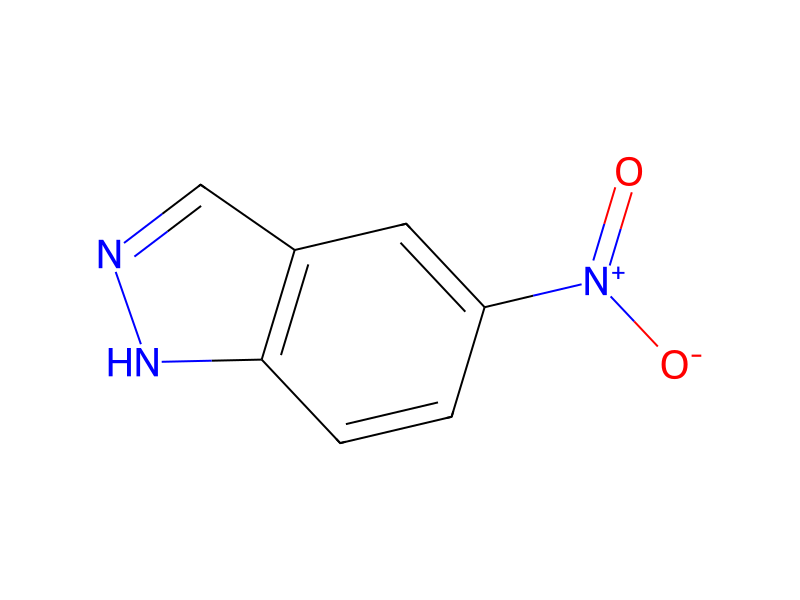
5-Nitroindazole → HCID 178526490, compound
Reaction equation

[N+:1]([C:4]1[CH:5]=[C:6]2[C:10](=[CH:11][CH:12]=1)[NH:9][N:8]=[CH:7]2)([O-:3])=[O:2].[Br:13]Br>C(O)(=O)C>[Br:13][C:7]1[C:6]2[C:10](=[CH:11][CH:12]=[C:4]([N+:1]([O-:3])=[O:2])[CH:5]=2)[NH:9][N:8]=1Participants
4
Reactant 2

Product 1

Reagents, catalysts & solvents 1

Conditions
- Temperature
- 80 °C
Procedure
5-Nitroindazole (10 g, 61.3 mmol) was dissolved in acetic acid (170 mL) and the mixture heated to 80° C. Bromine (3.1 mL, 60.7 mmol) was added slowly and the mixture heated to reflux. After 2 hours, the reaction mixture was allowed to cool to room temperature, and the resulting precipitate filtered off. Additional product was isolated by concentrating the filtrate, partitioning the residue between chloroform and saturated sodium bicarbonate solution, separating and drying the organic phase over sodium sulfate. Concentration gave a solid which was combined with the original precipitate to give the title compound as a yellow solid (11.4 g, 77%). 1H NMR δ 7.74 (1H, d), 8.21 (1H, dd), 8.40 (1H, d), 14.06 (1H, brs); MS (ES−) m/e=240.
Workup
- temperaturethe mixture heated to reflux
- temperatureto cool to room temperature
- filtrationthe resulting precipitate filtered off
- customAdditional product was isolated
- concentrationby concentrating the filtrate
- custompartitioning the residue between chloroform and saturated sodium bicarbonate solution
- customseparating
- dry with materialdrying the organic phase over sodium sulfate
- concentrationConcentration
- customgave a solid which
Sources & evidence
- ORD record
- ord-11e6ac8c8ddd4a7d9d418a9a9a11ce87
- Source dataset
- uspto-grants-2006_05
- Patent number
- US07041687B2
Reaction notes
Loading…