Methanol → HCID 22139730, compound
Reaction equation

[F:1][C:2]1[CH:22]=[C:21]([F:23])[CH:20]=[CH:19][C:3]=1[O:4][C:5]1[C:14]([O:15][CH3:16])=[CH:13][CH:12]=[C:11]2[C:6]=1[CH:7]=[CH:8][C:9](SC)=[N:10]2.O[O:25][S:26]([O-:28])=O.[K+].[CH3:30]O>O>[F:1][C:2]1[CH:22]=[C:21]([F:23])[CH:20]=[CH:19][C:3]=1[O:4][C:5]1[C:14]([O:15][CH3:16])=[CH:13][CH:12]=[C:11]2[C:6]=1[CH:7]=[CH:8][C:9]([S:26]([CH3:30])(=[O:28])=[O:25])=[N:10]2Participants
5
Reactant 3


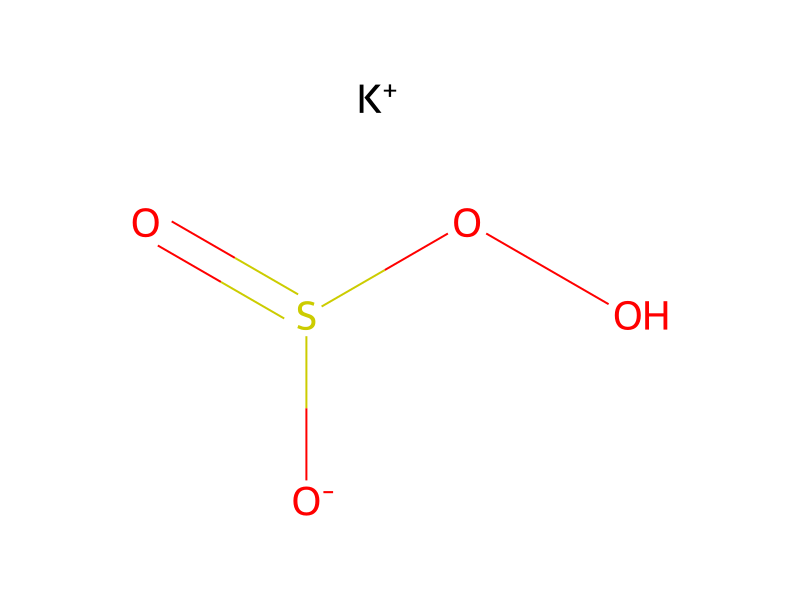
Product 1

Reagents, catalysts & solvents 1

Procedure
A solution of 0.25 g of 5-(2,4-difluoro-phenoxy)-6-methoxy-2-methylsulfanyl-quinoline in 10 mL of methanol was treated with aqueous OXONE™ solution (1.3 g in 5 mL H2O) and stirred for 2 hours at room temperature. The reaction mixture was partitioned between water and dichloromethane, the organic layer was dried (MgSO4), and the solvent was removed under vacuum. The solid residue was dissolved in a minimum amount of dichloromethane and washed through a silica gel plug to remove the baseline impurities. Elution with 30% EtOAc/hexane yielded 0.11 g (38%) of 5-(2,4-difluoro-phenoxy)-2-methanesulfonyl-6-methoxy-quinoline 701 ([M+H]+)=366, as white crystals.
Workup
- customThe reaction mixture was partitioned between water and dichloromethane
- dry with materialthe organic layer was dried (MgSO4)
- customthe solvent was removed under vacuum
- dissolutionThe solid residue was dissolved in a minimum amount of dichloromethane
- washwashed through a silica gel plug
- customto remove the baseline impurities
- washElution with 30% EtOAc/hexane
Sources & evidence
- ORD record
- ord-8c33fe9a989d4b62aee5328d439cb55b
- Source dataset
- uspto-grants-2006_05
- Patent number
- US07049325B2
Reaction notes
Loading…