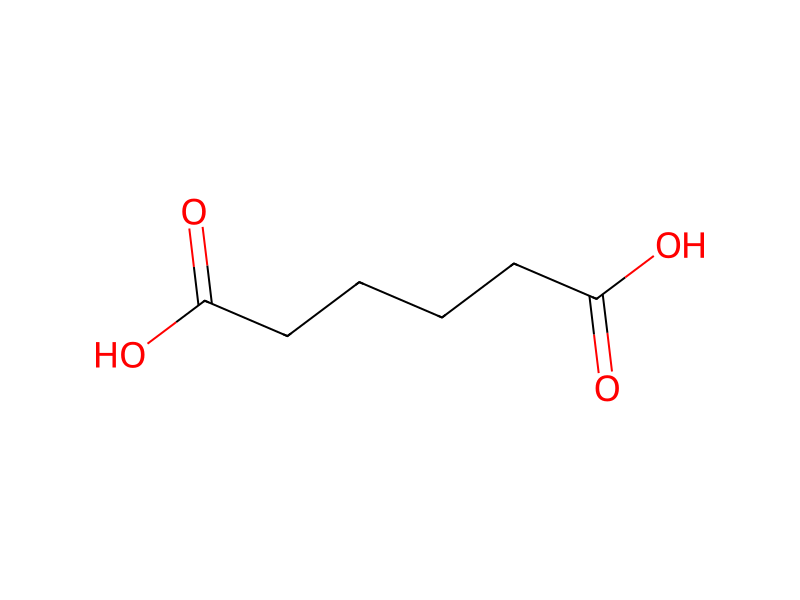
Adipic Acid → HCID 21885611, compound
Reaction equation

[C:1]([OH:10])(=[O:9])[CH2:2][CH2:3][CH2:4][CH2:5][C:6]([OH:8])=[O:7].[C:11]1([CH2:19][NH2:20])[CH:16]=[CH:15][CH:14]=[C:13]([CH2:17][NH2:18])[CH:12]=1>>[C:11]1([CH2:19][NH2:20])[CH:16]=[CH:15][CH:14]=[C:13]([CH2:17][NH2:18])[CH:12]=1.[C:1]([OH:10])(=[O:9])[CH2:2][CH2:3][CH2:4][CH2:5][C:6]([OH:8])=[O:7]Participants


Procedure
Generally, the melting point of aromatic dicarboxylic acid is higher than that of straight-chain α,ω-aliphatic dicarboxylic acid. Therefore, there is a temperature range in which a mixture of dicarboxylic acids is in a suspension phase comprising a molten straight-chain α,ω-aliphatic dicarboxylic acid and a solid aromatic dicarboxylic acid not dissolved in the molten straight-chain α,ω-aliphatic dicarboxylic acid. For example, since adipic acid melts at 170° C. but the aromatic dicarboxylic acid generally remains solid without dissolved in the molten straight-chain α,ω-aliphatic dicarboxylic acid at this temperature, a mixture thereof is in a suspension phase. If a large amount of m-xylylenediamine is added dropwise into a mixture in the suspension phase, the added m-xylylenediamine reacts with the molten adipic acid in preference to the solid aromatic dicarboxylic acid. Therefore, the reaction between m-xylylenediamine with the aromatic dicarboxylic acid does not proceed sufficiently. In addition, the m-xylylenediamine/aromatic dicarboxylic acid repeating units are not randomly introduced in the backbone, but the m-xylylenediamine/adipic acid repeating units and the m-xylylenediamine/aromatic dicarboxylic acid repeating units respectively form distinct blocks, thereby likely to result in the failure of reducing the melting point of polyamide as well as likely to make the mechanical and chemical properties unstable.
Sources & evidence
- ORD record
- ord-f1732a7046664a078ae27a08ab5a1858
- Source dataset
- uspto-grants-2006_05
- Patent number
- US07053171B2
Reaction notes
Loading…