Pyridine → HCID 22046709, compound
Reaction equation

[C:1](Cl)([O:3][CH2:4][C:5]([Cl:8])([Cl:7])[Cl:6])=[O:2].[I:10][C:11]1[CH:19]=[C:15]([C:16]([OH:18])=[O:17])[C:14]([NH2:20])=[CH:13][CH:12]=1.N1C=CC=CC=1>ClCCl>[I:10][C:11]1[CH:12]=[CH:13][C:14]([NH:20][C:1]([O:3][CH2:4][C:5]([Cl:8])([Cl:7])[Cl:6])=[O:2])=[C:15]([CH:19]=1)[C:16]([OH:18])=[O:17]Participants
Reactant 3

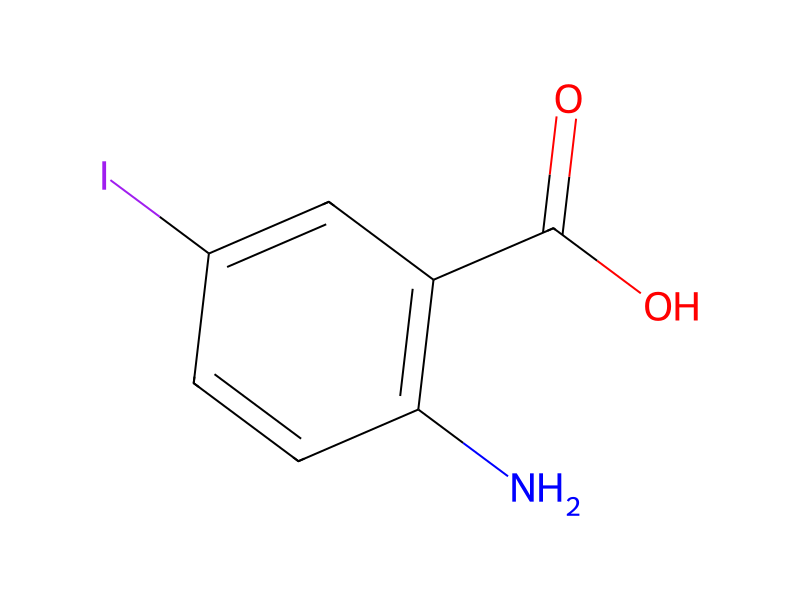

Product 1

Reagents, catalysts & solvents 1

Procedure
A solution of Troc-Cl (2.88 mL, 20.9 mmol) in dry dichloromethane (20 mL) was added drop wise to a solution of 5-iodoanthranilic acid 131 (5 g, 19 mmol) and pyridine (3.1 mL, 38 mmol) in dry dichloromethane (30 mL) at 0° C. The solution was stirred for 5 hours at room temperature and then washed with 1N HCl (2×25 mL), water (1×25 mL) and brine (1×25 mL). The organic phase was dried over MgSO4 and evaporated, residue was recrystallized from ethyl acetate to afford the title compound as a yellow solid (6.2 g, 75%): m.p. 248 C (ethyl acetate). 1H NMR (CDCl3, DMSO-d6) δ4.83 (s, 2H); 7.78-7.82 (dd, J=9.2, J=2.2 Hz, 1H); 8.18 (d, J=9 Hz, 1H); 8.38 (d, J=2.2 Hz, 1H); 9.0-10.5 (bs, 1H); 11.04 (s, 1H). 13C NMR (CDCl3, DMSO-d6) δ74.4, 84.6, 95.2, 117.7, 120.7, 140, 140.8, 142.8, 151.5, 169. MS: m/e (relative intensity) 437 (M−1, 60), 289 (55), 272 (37), 245 (100), 218 (27). HRMS Calculated for C10H7Cl3INO4: 436.8485. Found: 436.8485.
Workup
- washwashed with 1N HCl (2×25 mL), water (1×25 mL) and brine (1×25 mL)
- dry with materialThe organic phase was dried over MgSO4
- customevaporated
- customresidue was recrystallized from ethyl acetate
Sources & evidence
- ORD record
- ord-e5775f0f75694b22bc69501c8904d0ea
- Source dataset
- uspto-grants-2006_06
- Patent number
- US07067511B2
Reaction notes
Loading…