Phenol → Phenyl isocyanate
Reaction equation

C(=O)(OC1C=CC=CC=1)OC1C=CC=CC=1.[CH:17]([NH:19][C:20]1[CH:25]=[CH:24][CH:23]=[CH:22][CH:21]=1)=[O:18].C1(O)C=CC=CC=1.C1(O)C=CC=CC=1.C(NC1C=CC=CC=1)=O>>[C:20]1([N:19]=[C:17]=[O:18])[CH:25]=[CH:24][CH:23]=[CH:22][CH:21]=1Participants


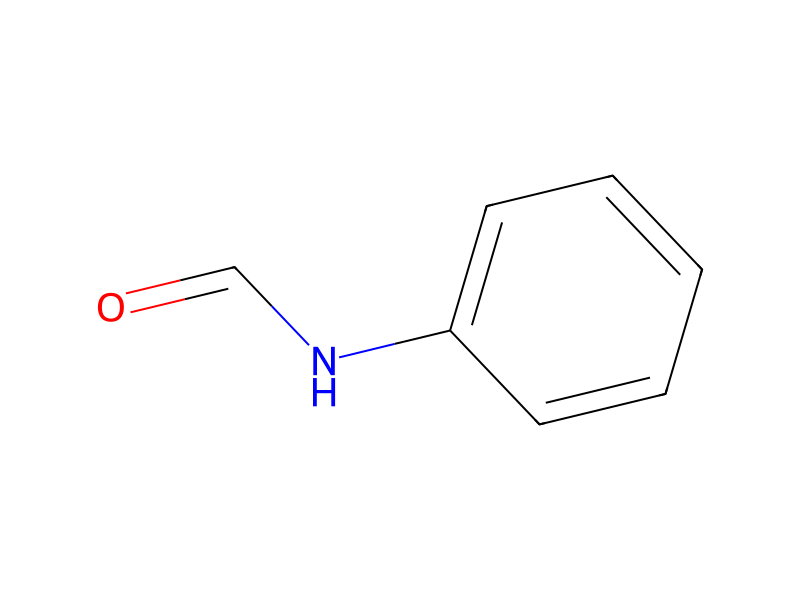


Procedure
Diphenyl carbonate (33.2 grams, 0.155 mole) is charged to a 50 ml three-neck flask equipped with a magnetic stirbar, a six inch Vigreaux column topped with a short path distillation head and an electrically heated addition funnel charged with a solution of formanilide (4.69 grams, 0.039 mole) in molten phenol (16.56 grams, 0.176 mole). The diphenyl carbonate is heated to 213° C. at 100 mmHg vacuum and the phenol/formanilide mixture added dropwise over a 50 minute period. When the addition is complete, the vacuum is slowly lowered to 5 mmHg over the next 10 minutes to remove the remaining phenol and phenyl isocyanate from the remaining diphenyl carbonate. Internal standard gas chromatographic (IS/GC) analysis of the overhead (29.72 grams) and pot material (22.94 grams) shows production of 4.17 grams of phenyl isocyanate and 0.02 grams of phenyl isocyanate as phenol carbamate, as a solution in phenyl formate and phenol, a recovery of 0.0352 moles of phenyl isocyanate (91.0% yield, based on formanilide fed). In calculating the yield of isocyanate, the easily thermolyzed carbamate is considered as isocyanate.
Workup
- customequipped with a magnetic stirbar
- distillationa six inch Vigreaux column topped with a short path distillation head
- additionan electrically heated addition funnel
- additionWhen the addition
- customis slowly lowered to 5 mmHg over the next 10 minutes
- customto remove the remaining phenol and phenyl isocyanate from the remaining diphenyl carbonate
Sources & evidence
- ORD record
- ord-83ed324710ad427abce911a4027c8530
- Source dataset
- uspto-grants-2004_08
- Patent number
- US06781010B1
Reaction notes
Loading…