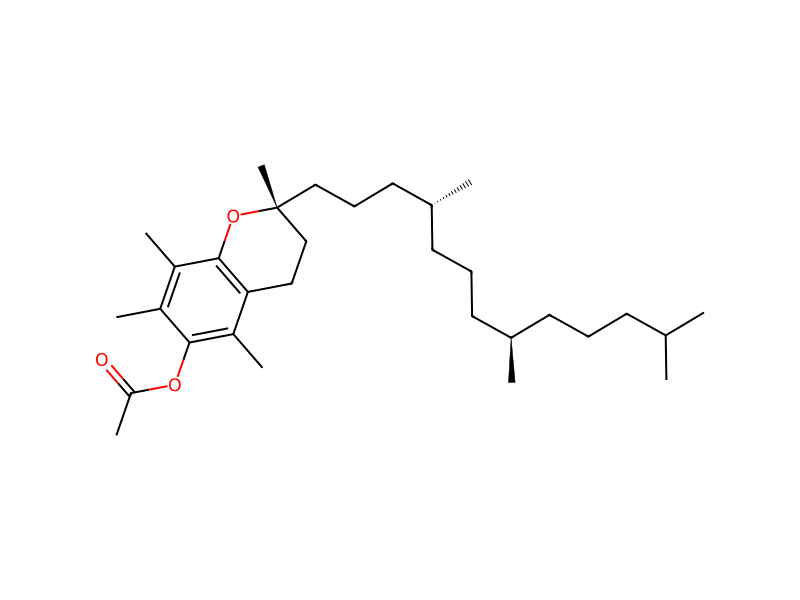
Acetic Anhydride → Alpha-Tocopherol Acetate
Reaction equation

[CH3:1][C:2]1[C:3]([OH:11])=[C:4]([CH3:10])[C:5]([CH3:9])=[C:6]([CH:8]=1)O.[CH3:12][CH:13]([CH2:15][CH2:16][CH2:17][CH:18]([CH2:20][CH2:21][CH2:22][CH:23]([CH2:25][CH2:26][CH2:27][C:28]([OH:32])([CH:30]=[CH2:31])[CH3:29])[CH3:24])[CH3:19])[CH3:14].[C:33](OC(=O)C)(=[O:35])[CH3:34].B([O-])([O-])[O-]>>[CH3:9][C:5]1[C:6]2[O:32][C@@:28]([CH2:27][CH2:26][CH2:25][C@@H:23]([CH2:22][CH2:21][CH2:20][C@@H:18]([CH2:17][CH2:16][CH2:15][CH:13]([CH3:12])[CH3:14])[CH3:19])[CH3:24])([CH3:29])[CH2:30][CH2:31][C:8]=2[C:2]([CH3:1])=[C:3]([O:11][C:33]([CH3:34])=[O:35])[C:4]=1[CH3:10]Participants



Procedure
EP 0 784 042 claimed hydrogen bis(oxalato)borate as protic acid catalyst for the Friedel-Crafts condensation of trimethylhydroquinone with isophytol and the acylation of phenols, for example tocopherol. In an example the acylation of tocopherol is described. For this, tocopherol was charged into a flask together with acetic anhydride and hydrogen bis(oxalato)borate and the reaction mixture was heated to reflux for one hour under an argon atmosphere. The initial molar ratio of acetic anhydride/tocopherol was greater than 1.1 mol/mol and the borate concentration was approximately 0.5 mol %, based on tocopherol. After concentration on a rotary evaporator, tocopherol acetate was obtained in a purity of 87% at a yield of 92%. This batch process has the disadvantage that both yield and purity are still not satisfactorily high. In addition, carrying out the reaction in an argon atmosphere is associated with high costs for industrial production.
Workup
- temperaturethe reaction mixture was heated
- temperatureto reflux for one hour under an argon atmosphere
- concentrationAfter concentration
- customon a rotary evaporator
Sources & evidence
- ORD record
- ord-bff61d4b7a65495d8cd169531af4a7cb
- Source dataset
- uspto-grants-2004_08
- Patent number
- US06784303B2
Reaction notes
Loading…