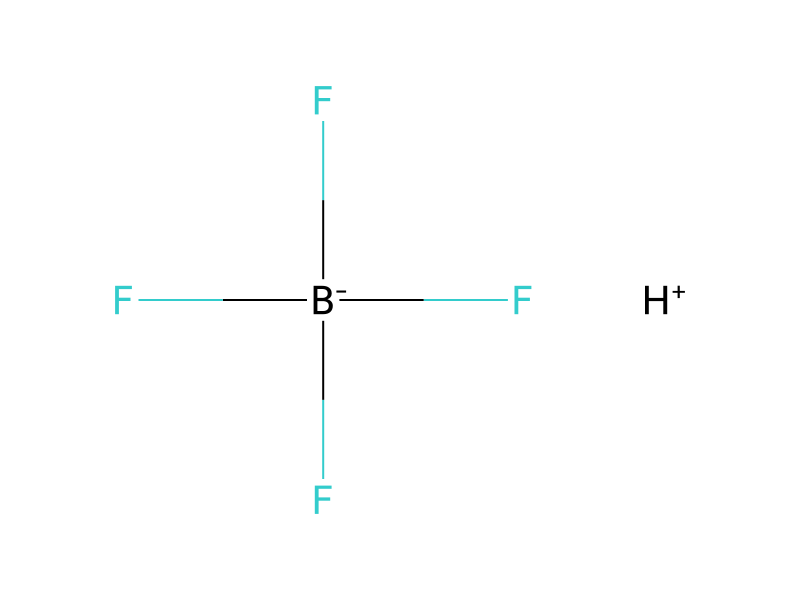
Tetrafluoroboric acid → Triethylmethylammonium Tetrafluoroborate
Reaction equation

[F:1][B-:2]([F:5])([F:4])[F:3].[H+].OC(C)(C)C([O-])=O.[CH2:14]([N+:16]([CH2:20][CH3:21])([CH2:18][CH3:19])[CH3:17])[CH3:15]>>[F:1][B-:2]([F:5])([F:4])[F:3].[CH2:14]([N+:16]([CH2:20][CH3:21])([CH2:18][CH3:19])[CH3:17])[CH3:15]Participants


Procedure
The reaction was carried out in the same manner as in Example 7 except for using in the second step 105 g (0.5 mol) of a 42% aqueous solution of tetrafluoroboric acid in place of the ethanol solution thereof, and 110 g (6.1 mol) of an aqueous solution of triethylmethylammonium 2-hydroxyisobutyrate in place of the ethanol solution thereof. No generation of gas due to by-production was observed, and the reaction liquid was homogeneous. The still residue after evaporation of the reaction liquid to dryness was recrystallized from ethanol and vacuum dried to obtain 89 g (0.44 mol) of triethylmethylammonium tetrafluoroborate. The purity was 99.0% by weight, the yield was 88.7 mol % based on triethylmethylammonium 2-hydroxyisobutyrate, and the moisture content of the crystal was 360 ppm.
Workup
- customthe reaction liquid
- customThe still residue after evaporation of the reaction liquid to dryness
- customwas recrystallized from ethanol and vacuum
- customdried
Sources & evidence
- ORD record
- ord-9558d3da8ac14bb0a349a0eba7c3502b
- Source dataset
- uspto-grants-2004_08
- Patent number
- US06784317B2
Reaction notes
Loading…