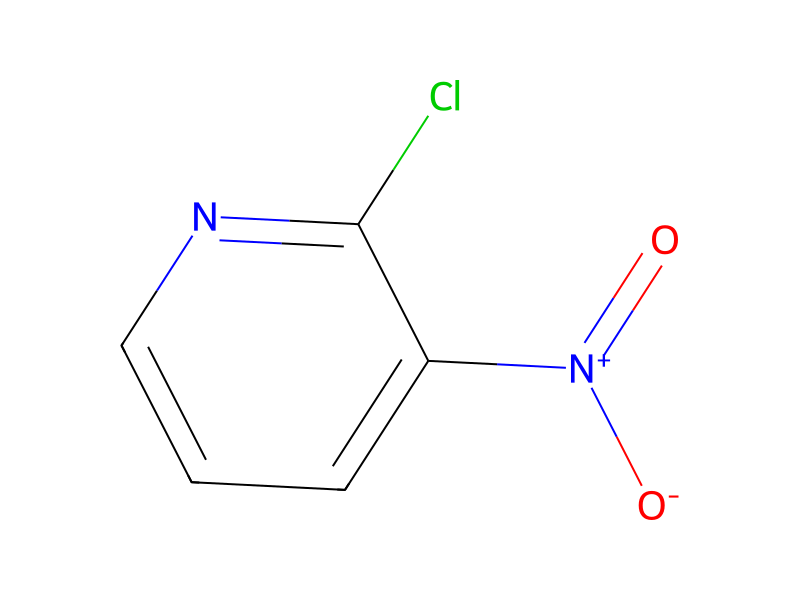
2-Chloro-3-nitropyridine → HCID 67342130, compound
Reaction equation

Cl[C:2]1[C:7]([N+:8]([O-])=O)=[CH:6][CH:5]=[CH:4][N:3]=1.[NH:11]1[CH2:16][CH2:15][CH:14]([CH2:17][CH2:18][N:19]2[CH2:24][CH2:23][CH2:22][CH2:21][CH2:20]2)[CH2:13][CH2:12]1>C(#N)C.[Pd]>[N:19]1([CH2:18][CH2:17][CH:14]2[CH2:15][CH2:16][N:11]([C:2]3[C:7]([NH2:8])=[CH:6][CH:5]=[CH:4][N:3]=3)[CH2:12][CH2:13]2)[CH2:20][CH2:21][CH2:22][CH2:23][CH2:24]1Participants
5
Reactant 2

Product 1

Reagents, catalysts & solvents 2


Conditions
- Temperature
- 80 °C
Procedure
To a solution of 0.317 g (2.00 mmol) of 2-chloro-3-nitro-pyridine in acetonitrile (10 mL) is added 0.393 g (2.00 mmol) of 1-(2-piperdin-4-yl-ethyl)-piperidine. The mixture is heated to 80° C. and stirred overnight. The mixture is cooled to room temperature and concentrated under reduced pressure. The crude residue is dissolved in ethanol (10 mL) and treated with 0.050 g (0.05 mmol) of 10% palladium on carbon. The mixture is placed under an atmosphere of hydrogen and stirred overnight at room temperature. The mixture is concentrated under reduced pressure to provide 0.577 g (quant.) of 4-(2-piperidin-1-yl-ethyl)-3,4,5,6-tetrahydro-2H-[1,2′]bipyridinyl-3′-ylamine.
Workup
- temperatureThe mixture is cooled to room temperature
- concentrationconcentrated under reduced pressure
- dissolutionThe crude residue is dissolved in ethanol (10 mL)
- stirringstirred overnight at room temperature
- concentrationThe mixture is concentrated under reduced pressure
Sources & evidence
- ORD record
- ord-865d2017879d41cca1f6e8e6ea0fb29a
- Source dataset
- uspto-grants-2015_02
- Patent number
- US08952004B2
Reaction notes
Loading…