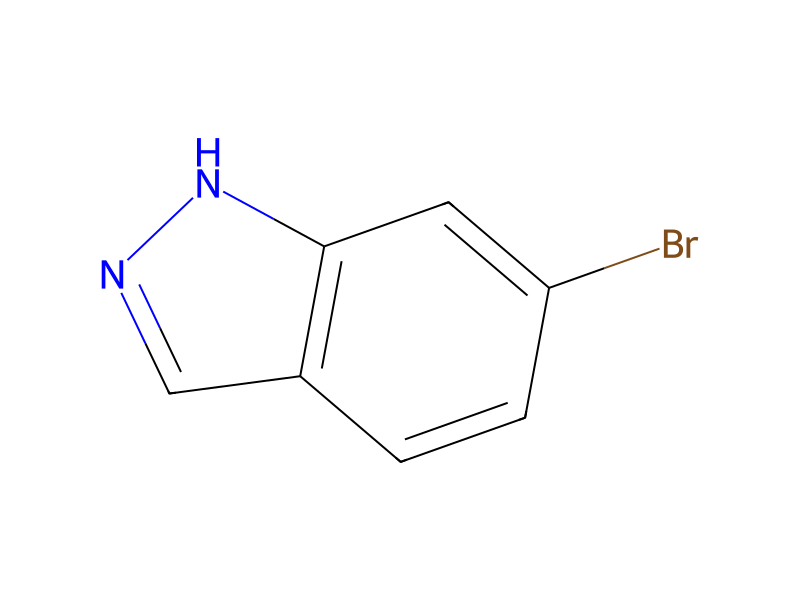
Hydrazine → 6-Bromo-1H-indazole
Reaction equation

F[C:2]1[CH:9]=[C:8]([Br:10])[CH:7]=[CH:6][C:3]=1[CH:4]=O.[NH2:11][NH2:12]>C(COC)OC>[Br:10][C:8]1[CH:9]=[C:2]2[C:3]([CH:4]=[N:11][NH:12]2)=[CH:6][CH:7]=1Participants
4
Reactant 2


Product 1
Reagents, catalysts & solvents 1

Procedure
A solution of 2-fluoro-4-bromobenzaldehyde (5.09 g, 25 mmol) was dissolved in glyme (25 mL) and slowly treated over 10 minutes with anhydrous hydrazine (25 mL, 0.8 mol, 32 eq.). The resulting biphasic mixture was then held at reflux overnight. The reflux condenser was replaced with a short-path distillation head and about half the solvent distilled, at which time the reaction flask showed one phase and two phases were evident in the distillate. The undistilled residue was cooled and treated with water (25 mL), forming a white precipitate. This solid was collected by filtration, washed thoroughly with water, and dried in vacuo to give 6-bromoindazole (4.21 g, 85%) as white crystals.
Workup
- temperatureat reflux overnight
- distillationdistilled, at which time the reaction flask
- temperatureThe undistilled residue was cooled
- additiontreated with water (25 mL)
- customforming a white precipitate
- filtrationThis solid was collected by filtration
- washwashed thoroughly with water
- customdried in vacuo
Sources & evidence
- ORD record
- ord-f089a3b2c4384aa99f96dd2222aa0c2f
- Source dataset
- uspto-grants-2015_02
- Patent number
- US08957049B2
Reaction notes
Loading…